

The Only Problem Is… It’s Not a Watch.
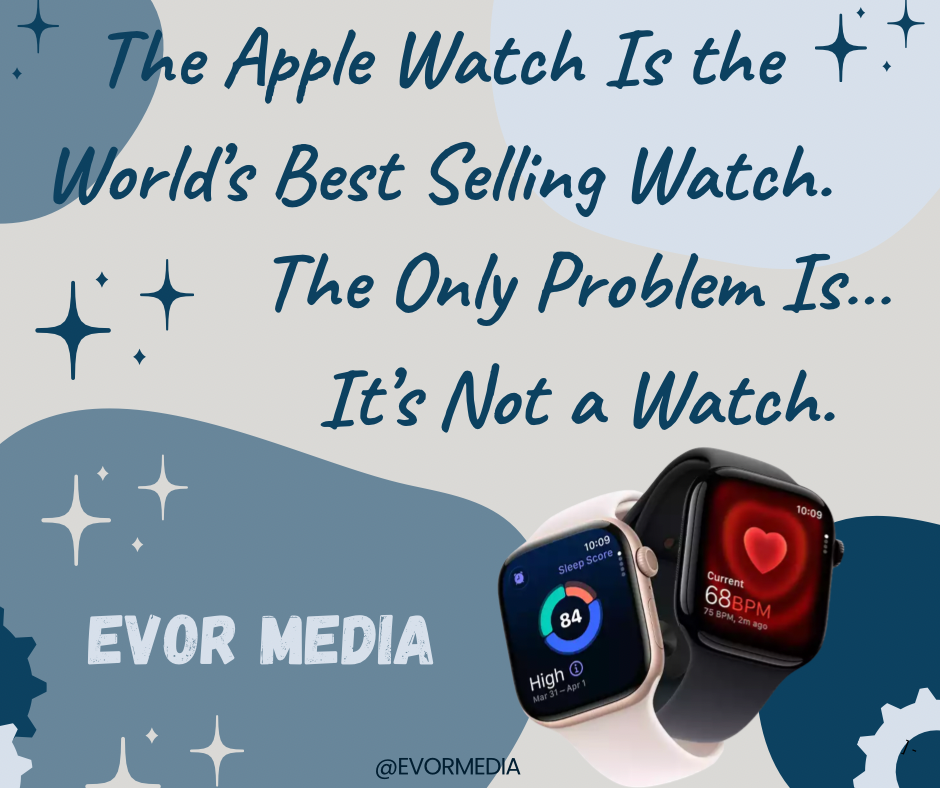
Apple now sells more watches than anyone else on Earth. More than Rolex. More than Omega. More than Swatch. Combined. Safe to say the Apple Watch filled a technological need, but that need was not time keeping.
This is usually presented as a triumph—another industry quietly conquered by Cupertino. A clean headline. A tidy chart. A victory lap for a company that seems to collect entire markets the way others collect loyalty points. And yet, sitting with that fact for more than a moment produces a strange sense of unease. Because while Apple may sell the most watches in the world, almost no one buys an Apple Watch because they want a watch…they buy it because it buzzes.
For most of human history, a watch did one job, and did it well. It told time. Later, it told a bit more than that—who you were, what you valued, where you fit. A watch was a tool, then a piece of jewelry, then a quiet declaration of taste. It was something you maintained, not something you replaced. Something you wound, repaired, passed down. Even the humble quartz watch aspired to permanence. You didn’t update a watch. You lived with it.
The Apple Watch, by contrast, arrives preloaded with the assumption that it will be temporary.
When Apple first introduced it in 2015, the company seemed unsure of what it had made. The launch leaned heavily into fashion. There were glossy magazine spreads. Multiple bands. Even a solid gold “Edition” model that cost as much as a small car. Apple appeared to believe it was entering the luxury watch market head-on, as if centuries of horological tradition were simply another industry awaiting disruption.
That phase didn’t last long.
Within a few product cycles, the illusion slipped. The gold models vanished. The fashion talk quieted. The Apple Watch stopped pretending to compete with Swiss watchmakers and instead became what it always was: a small computer strapped to your wrist, trying to justify its existence between heartbeats.
Today, the Apple Watch is many things, but it is not—at least not primarily—a timekeeping device. It is a notification mirror, a fitness conscience, a health monitor, an iPhone accessory that whispers instead of rings. The time is almost incidental. You don’t look at an Apple Watch because you’re curious what hour it is. You look because something happened.
A message arrived. A ring needs closing. Your heart did something interesting.
This is where Apple succeeded in a way no one else quite has. Fitness trackers had existed for years before the Apple Watch. Smartwatches too. But they often felt like gadgets searching for a lifestyle. Apple reversed the strategy. It took something people already wore and smuggled in an entirely different category of product.
The Apple Watch isn’t really a watch. It’s a health device that happens to tell time.
This distinction matters, because it explains both its dominance and its discomfort. The most compelling features of the Apple Watch are not glamorous. They are quietly profound. Heart-rate alerts. ECG readings. Fall detection. Crash detection. Stories of lives saved not by heroics, but by sensors noticing something wasn’t quite right. This is not horology. This is preventative medicine, disguised as an accessory.
And yet, calling it a health monitor wouldn’t have worked. Few people would voluntarily strap a medical device to their wrist all day, every day. Calling
it a watch made it acceptable. Familiar. Harmless. Almost traditional.
Traditional watchmakers, for their part, were never really in danger. Apple didn’t steal their customers; it simply created a parallel universe. A Rolex is not obsolete because an Apple Watch exists. They solve entirely different emotional problems. One aspires to timelessness. The other assumes replacement. One grows more meaningful with age.
This is a test
The other politely suggests an upgrade every few years.
This is perhaps the strangest tension at the heart of Apple’s success: the Apple Watch is something you wear like jewelry but treat like an appliance. It lives on your body, yet ages like a phone. Scratches don’t tell stories; they signal trade-in value. A dead battery isn’t repaired—it’s retired.
So what, then, should we call this thing?
A wrist computer feels too technical. A health tracker feels too clinical. An iPhone accessory feels dismissive. “Watch” remains the least wrong word available, even if it stretches the definition beyond recognition.
And maybe that’s the real achievement. Apple didn’t just make the world’s best-selling watch. It quietly redefined what a watch is allowed to be. Not a keeper of time, but a keeper of attention. Not a symbol of permanence, but a companion to the present moment. Something less about hours and minutes, and more about nudges, rings, and gentle reminders that your body is, at this very second, doing something worth measuring.
The Apple Watch wins not by honouring the past of watches, but by moving beyond it entirely. It succeeds by wearing a familiar name like a disguise—just enough tradition to feel comfortable, just enough technology to feel inevitable.
And that may be Apple’s greatest trick of all: building the world’s most successful watch by making something that, deep down, doesn’t really want to be one.
Leave a Reply