
A 1947 SEARS RADIO-PHONOGRAPH
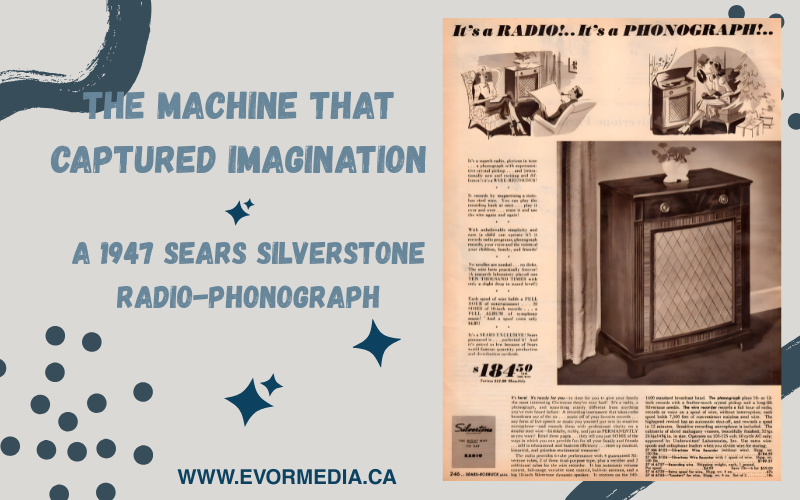
There’s something magical about flipping through an old Christmas catalog, especially one from 1947. Back then, technology wasn’t something you upgraded annually; it was a significant investment. It became a part of your home, your family, quietly shaping your memories.
One item that caught my eye was a combination radio-phonograph from Sears. Priced at $184.50, that’s just over $3,000 today, a substantial purchase in the years following World War II. This wasn’t an impulse buy; it was a statement, a centrepiece, a promise of connection, entertainment, and perhaps even a touch of wonder.
And honestly, it delivered all of that and more.
A Radio… and a Phonograph… and Something Entirely New
Sears didn’t just sell this as furniture or an appliance; they sold it as an experience.
“It’s a radio… it’s a phonograph… and sensationally new… it’s a wire recorder.”
That last part is what makes this machine so captivating. We take recording for granted today, with our phones capturing hours of audio in seconds. But in 1947, the idea of recording anything radio broadcasts, your favourite records, or even your own voice and playing it back instantly felt like science fiction.
This system used a thin strand of stainless steel wire, magnetized to store sound. No discs, no grooves, no needles. Just 7,500 feet of wire spooling through the machine, capturing moments as they happened.
The promise was bold:
- Record a full hour without interruption
- Replay it instantly
- Erase it and reuse it repeatedly
- Listen to it thousands of times with barely any loss in quality
It wasn’t just playback; it was preservation.
A Window Into Another World
My father, born in 1942, was a child of the golden age of radio. He often reminisced about lying on the floor, completely absorbed in his favourite programs.
No screens, no visuals—just sound and imagination.
When I read this catalog description, I can’t help but picture him there. Perhaps in a dimly lit living room, the glow of vacuum tubes warming a polished wooden cabinet. A radio like this one filled the space with stories, music, and voices from far away.
This wasn’t passive entertainment. It demanded participation. You had to listen, and in doing so, your mind crafted worlds, faces, and scenes from nothing but sound.
That’s something we’ve lost a bit of today.
Built Like It Mattered
Everything about this machine reflects a different philosophy of technology. It boasted:
- Six-tube radio performance (plus two more for the recorder)
- Large 10-inch dynamic speaker
- Full-range tone control and automatic volume control
- Built-in antenna
- Phonograph capable of playing 10- and 12-inch records
All housed in a beautifully finished mahogany cabinet.
This wasn’t just electronics; it was furniture. It had presence, belonging in your home alongside a piano or dining table.
Even the futuristic wire recorder came with practical touches: high-speed rewind, automatic shutoff, and a simple interface that Sears claimed even a child could operate.
The Real Value Wasn’t the Technology
Reading through the description, you begin to notice something: Sears wasn’t just selling features. They were selling possibility.
The ability to:
- Capture family voices
- Preserve music collections
- Record important moments
- Create entertainment for gatherings
- Even improve “educational and business efficiency”
But beneath all that, they were truly offering something deeper—a memory.
Imagine recording your child’s voice for the first time. Or saving a favourite radio broadcast to listen to again. Or capturing a family moment that would otherwise be lost forever.
In 1947, that wasn’t just convenient; it was revolutionary.
A Different Kind of Christmas Gift
The catalog promised this would be:
“The most interesting Christmas they’ve ever had.” You can see why.
This wasn’t just a toy; it was an experience generator, a storytelling machine, a way to bring people together in a world still rebuilding itself after war.
Imagine a family gathered around it on Christmas morning, curious and excited, perhaps a bit confused about how this futuristic device worked. Slowly, they would realize its potential.
Looking back from 2026, we carry devices in our pockets that make this machine seem primitive. We stream millions of songs instantly, record hours of audio without thinking, and skip, rewind, and replay with a tap.
But here’s the thing: convenience has replaced ceremony.
Back then, listening was intentional, recording was meaningful, and owning something like this wasn’t about having the latest tech—it was about what it enabled: connection, imagination, and memory.
The Sears radio-phonograph isn’t just old equipment; it’s a snapshot of a time when technology felt magical, when capturing sound felt like capturing life itself.
And maybe that’s why it resonates so much.
Because somewhere in that description—the polished wood, the glowing tubes, the spinning wire—lies a simple idea: that the voices we hear, the music we love, and the moments we live are worth holding onto, even if it takes 7,500 feet of steel wire to do it.