What Changed…and What Didn’t
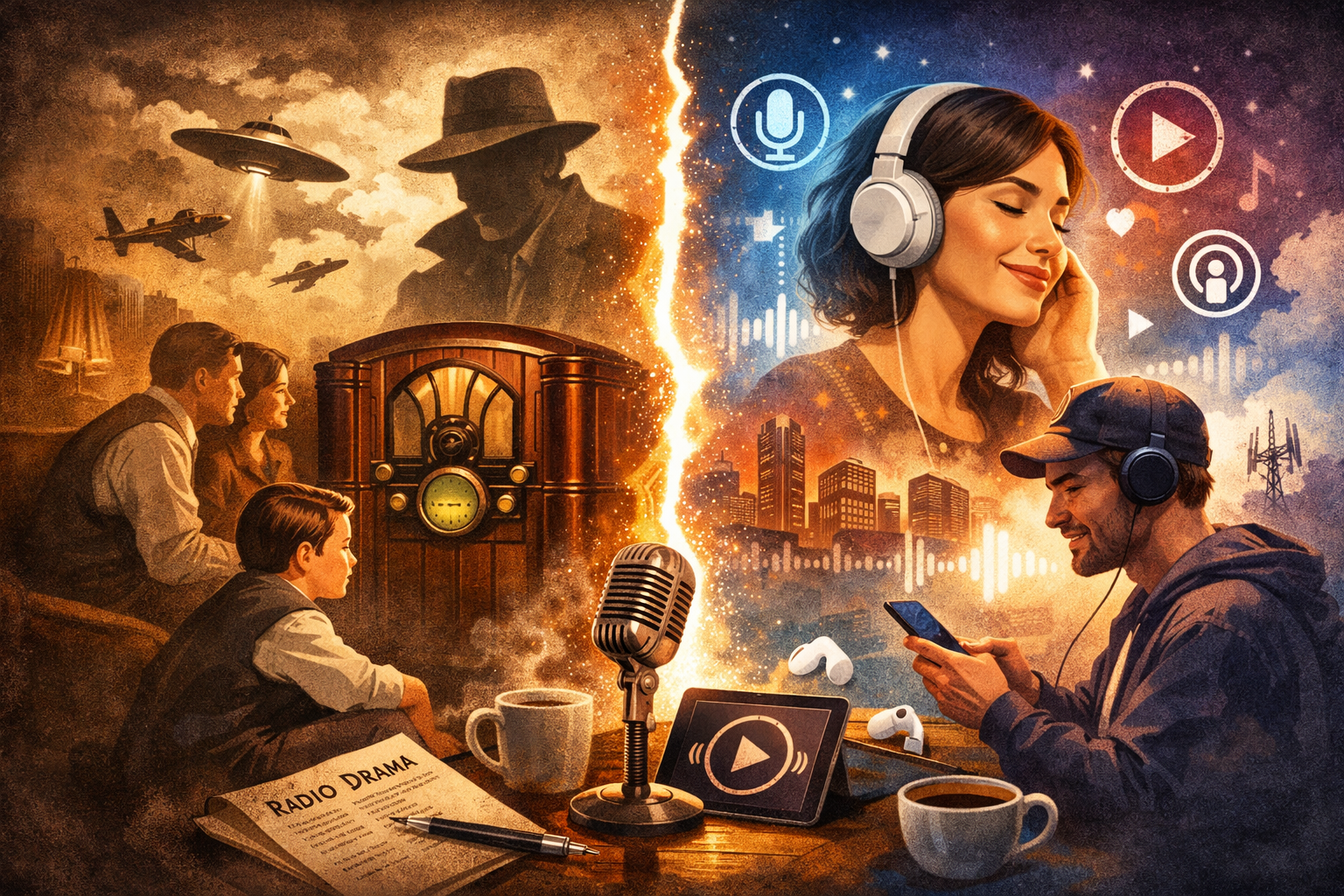
There was a time when families would gather around a radio, waiting for a story to begin
- Not scrolling.
- Not skipping.
- Waiting.
In the 1930s and 40s, radio dramas weren’t just entertainment—they were events. Shows like The Shadow radio program and The War of the Worlds broadcast captured the imagination of millions. People sat together, listening closely, building entire worlds in their minds from nothing but sound.
Today, we live in what feels like a completely different universe. Podcasts stream on demand. Audiobooks follow us everywhere. Voices live in our ears through devices like Apple AirPods.
But when you strip away the technology, something surprising becomes clear:
- A lot has changed.
- And almost nothing has.
What Changed: Control, Convenience, and Choice
The biggest shift from radio dramas to podcasts is simple: control.
In the golden age of radio, you listened when the show aired. Miss it, and it was gone. That limitation created a kind of shared rhythm—entire cities tuned in at the same time.
Today, podcasts have flipped that entirely.
- Listen anytime
- Pause, rewind, skip
- Choose from millions of shows
Platforms like Spotify and Apple Podcasts have made audio deeply personal. Your listening habits are no longer shaped by a broadcast schedule—they’re shaped by you (and, increasingly, by algorithms).
It’s better in almost every measurable way.
But it’s also different in ways that are harder to measure.
What Changed: From Shared Rooms to Personal Spaces
Radio was a room experience.
Podcasts are a headphone experience.
That shift—from speakers to earbuds—quietly transformed how we connect through audio. What was once communal is now individual. We’ve traded the living room for the inside of our own heads.
We don’t gather to listen anymore.
We listen alone—together, but separate.
And while that independence is powerful, it comes with a subtle cost: fewer shared moments.
What Didn’t Change: The Power of Voice
Despite all the technological change, the core of audio storytelling remains exactly the same…a voice, telling a story.
Whether it’s a 1940s announcer leaning into a microphone or a modern podcast host speaking into a USB mic, the connection is still deeply human. Audio has an intimacy that video often lacks.
There’s no screen to distract you.
No visuals to define things for you.
Just voice—and your imagination filling in the rest.
That hasn’t changed at all.
What Didn’t Change: Imagination Does the Heavy Lifting
One of the most powerful things about radio dramas was what they didn’t show you.
There were no visuals—only suggestion. A creaking door. Footsteps in the dark. A pause in someone’s voice…your mind did the rest.
Podcasts—especially narrative ones—still rely on that same magic. Even today, the best audio stories don’t overwhelm you with detail. They leave space.
Space for you to imagine…space for you to participate.
In a world dominated by screens, that feels almost radical.
The Middle Ground We’re Still Figuring Out
If radio was communal and podcasts are personal, we’re still trying to figure out what comes next.
We have the tools to bring shared listening back—smart speakers, voice assistants, multi-room audio. Devices like the
Apple HomePod smart speaker can easily fill a room with sound.
But the habit isn’t there:
- We’ve grown used to listening alone.
- Curating our own tastes.
- Rarely compromising on what we hear.
And yet, there’s something missing.
A Small Experiment in Shared Listening
My wife and I have stumbled into a small way of reclaiming that lost connection.
When we go for walks, we share a single pair of AirPods—she takes the right, I take the left—and we listen to the same podcast.
It’s a simple thing. Almost silly.
But it creates moments that feel surprisingly rare: both of us reacting at the same time, stopping mid-step, looking at each other after hearing something that lands.
That shared reaction—that unplanned, synchronous moment—is something radio listeners in the 1940s would have recognized instantly.
The Real Difference
So what really changed?
- Not the storytelling.
- Not the voice.
- Not the imagination.
What changed is how we experience it together.
Radio made listening a collective ritual.
Podcasts made it a personal habit.
Neither is inherently better. But one of them brought people into the same moment—and the other lets us drift into our own.
Final Thoughts
We didn’t lose the magic of radio when podcasts arrived. In many ways, we expanded it.
We just redistributed it—from the room to the individual.
Maybe the next evolution of audio isn’t about better technology or smarter algorithms.
Maybe it’s about rediscovering something much older:
Listening, not just at the same time—
but together.