The Double-Edged Sword of AI Creativity
Not long ago, the path to becoming a recognized creative was guarded by formidable gates. If you wanted to make a film, you needed thousands of dollars in camera gear, lighting, and editing suites, not to mention a crew. If you wanted to produce an album, you needed to master complex music theory, learn an instrument, or pay rent-mortgaging prices for studio time. If you wanted to paint, you needed years of fine-motor practice to make the canvas match the vision in your head.
Today, those gates have not just been opened; they have been vaporized.
With tools like Midjourney, ChatGPT, Suno, and Sora, anyone with an internet connection and an imagination can generate a gallery-quality digital painting, a fully produced synth-pop track, a polished essay, or a cinematic video sequence in seconds.
We are living in the golden age of creative democratization. But this unprecedented access has triggered an equally powerful counter-force: hyper-saturation.
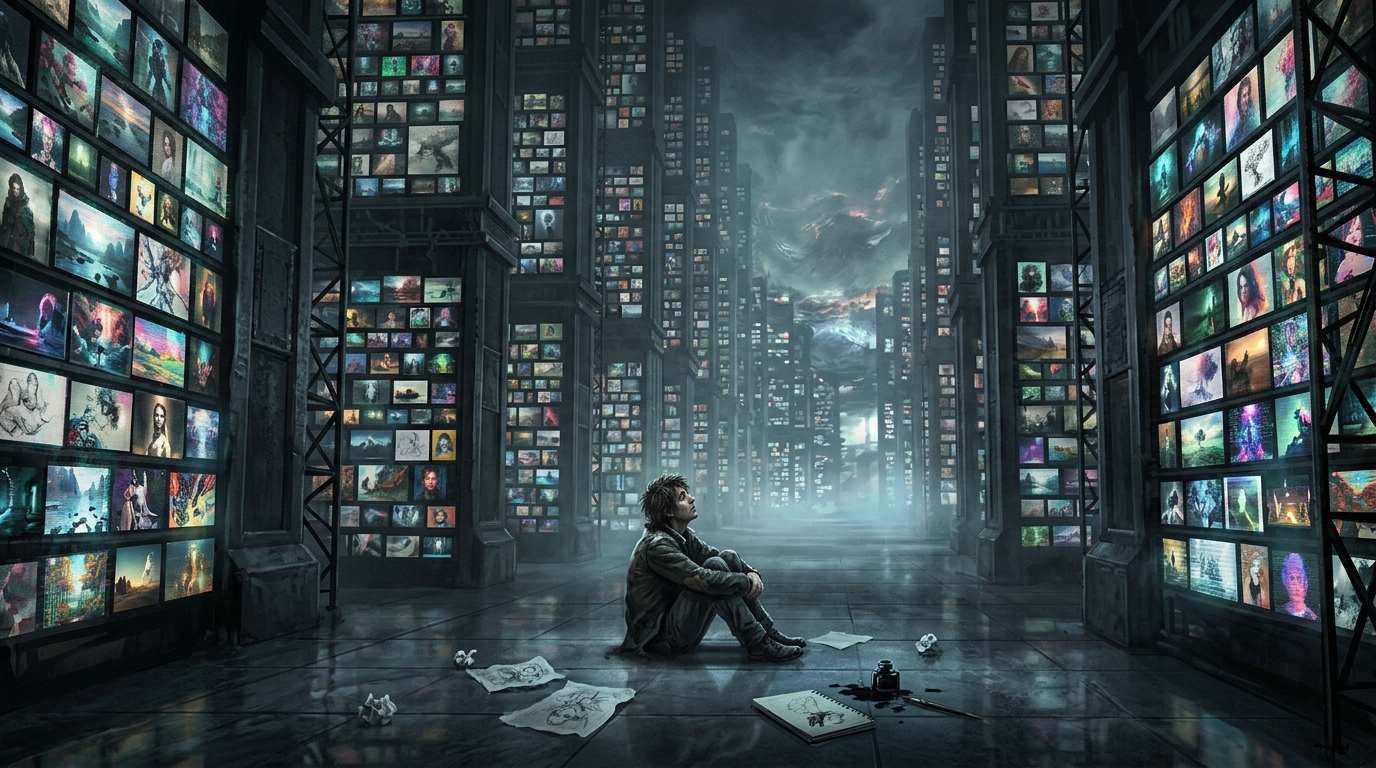
When everyone possesses the power to create instantly, the world is suddenly flooded with an ocean of content. We find ourselves trapped in a fascinating, exhausting paradox: it has never been easier to make art, and it has never been harder to get anyone to care about it.
For seasoned professionals and aspiring “want-to-be” creatives alike, this shift is simultaneously a massive win and an existential loss.
Part I: The Great Win — Democratizing the Human Imagination
To understand the beauty of this transition, we must first look at what generative AI actually does: it bridges the gap between intent and execution.
For centuries, human creativity has been limited by technical execution. Millions of brilliant stories have died in the minds of people who lacked the grammatical polish to write a novel. Spectacular visual worlds have remained locked inside the imaginations of those who couldn’t draw a straight line.
AI acts as a cognitive prosthesis. It takes the spark of an idea the prompt and handles the labor of translating it into a medium.
1. Empowering the “Want-to-Be” Creative
For the hobbyist, the dreamer, or the person who was told in middle school that they “weren’t the artistic type,” generative AI is a revelation. It is an invitation back into the playground of self-expression.
- A game designer who can’t draw can now sketch out concept art to pitch their indie game.
- A poet who doesn’t know how to read sheet music can hear their words sung by an AI-generated choir.
- A small business owner can craft a beautiful brand identity without a multi-thousand-dollar marketing agency budget.
This is a profound human victory. It removes the physical and financial barriers to self-expression, proving that creativity is not a specialized genetic trait reserved for a chosen few, but a fundamental human drive.
2. The Rise of the “Centaur” Creator
Even for established professionals, AI has supercharged the ideation phase. Writers use LLMs to break writer’s block, brainstorming plot points or generating character names. Illustrators use image generators to rapidly prototype layouts and color palettes before putting digital pen to paper.
This human-AI collaboration often referred to in tech circles as “centaur writing” or “centaur designing” allows creators to operate at a higher level of abstraction. Instead of spending hours meticulously rendering a shadow, they can spend that time thinking about the deeper concept, the emotional resonance, and the narrative arc.
Part II: The Great Loss The Sea of Noise and the Death of Scarcity
However, every technological revolution has a price. When you make the cost of producing something zero, its economic and psychological value behaves accordingly.
In economics, when supply becomes infinite, the value of an individual unit trends toward zero. This is the crisis of the creative saturation age.
Low Barriers to Entry ➔ Explosion of Creators ➔ Infinite Content Supply ➔ Collapse of Audience Attention
1. The Death of Scarcity and “Aesthetic Fatigue”
When beautiful things are difficult to make, we value them. When we look at a Renaissance painting or listen to a complex orchestral movement, we are appreciating two things simultaneously: the beauty of the piece, and the immense human sacrifice, time, and mastery required to build it.
AI removes the signal of effort. When an image that would have taken an artist three weeks to paint can be generated in four seconds, the magic evaporates. We look at a breathtakingly detailed image on our social media feeds, register that it’s “AI-generated,” and swipe past it in a millisecond. We are suffering from aesthetic fatigue. When everything is stunning, nothing is.
2. The Cacophony of the Feed
If anyone can create a polished piece of media in seconds, then everyone is.
Streaming platforms, social media feeds, and self-publishing storefronts are being buried under an avalanche of synthetic content. Spotify is flooded with thousands of AI-generated ambient tracks; Amazon’s Kindle store is inundated with low-effort, AI-written e-books; YouTube is packed with automated “faceless” channel videos generated from text prompts.
For the genuine “want-to-be” creative who has finally found their voice, this is a tragedy. They have finally acquired the tools to create, but they are shouting into a hurricane. The chances of their work being discovered, read, heard, or appreciated by another human being have plummeted.
Part III: The Professional Crisis The Devaluation of Craft
For those who earn their living through creative pursuits, the democratization of creativity feels less like a liberation and more like an eviction.
Traditional Creative Value:
[Technical Skill + Unique Vision] ➔ [Value to Clients/Audience]

The AI Disruption:
[AI Tool + Anyone's Prompt] ➔ [Sufficiently Good Output] (Bypassing Technical Skill)
The professional market is dividing into a brutal hierarchy:
1. The Collapse of the “Good Enough” Economy
Much of the creative economy does not rely on high art; it relies on “good enough” commercial art. This includes corporate copy, stock photos, background music for corporate videos, simple website designs, and basic illustrations.
This entire tier of the creative economy is being hollowed out. Clients who used to hire freelance writers or junior designers for $500 a project are now using subscription-based AI tools for $20 a month. While the AI output might not be a masterpiece, to the cost-conscious business owner, it is “good enough.”
This robs young, aspiring creatives of the very entry-level gigs they need to build their portfolios, hone their skills, and transition into true masters of their craft.
2. The Psychological Toll of the “Prompter”
There is a distinct psychological difference between making something and ordering something.
Traditional creativity is therapeutic because of the process. The physical act of painting, the struggle of rewriting a sentence, the physical muscle memory of playing a guitar chord, these acts trigger flow states, discipline, and emotional processing.
When creativity is reduced to prompting, we transition from creators to curators or consumers. We stand at a buffet, pointing at what we want, but we lose the spiritual connection that comes from cooking the meal ourselves. For many creatives, this shift feels hollow, leaving them feeling less like artists and more like software operators.
Part IV: The Future of Creativity How to Survive the Saturation
If we cannot stop the tide of AI content, how do human creators, both professional and amateur, survive and find meaning in this new landscape?
The answer lies in leaning into the things that AI cannot replicate: context, community, and friction.
| Creative Element | AI Output | Human Creator | | Production Speed | Instantaneous, high volume | Slow, deliberate, limited | | Core Source | Pattern recognition & statistical averages | Lived experience, trauma, joy, and physical limits | | Relationship | Transactional (tool to user) | Empathetic (human to human) | | Value Driver | Convenience and low cost | Authenticity, story, and effort |
1. The Premium on “Proof of Human”
As the digital space becomes increasingly synthetic, audiences will begin to crave “Proof of Human” (PoH). We will see a massive resurgence in the value of:
- The physical and tactile: Vinyl records, physical books, hand-painted canvases, live theater, and acoustic, unedited music performances.
- The flawed and imperfect: The slight tremor in a singer’s voice, the visible brushstroke, the quirky, non-linear logic of a human essayist. These “mistakes” are the fingerprints of humanity.
- The “Behind the Scenes”: Audiences will care more about how something was made. Documenting the creative process, the blood, sweat, tears, and mistakes, will become more valuable than the finished product itself.
2. Building Niche Communities
When discovery algorithms are broken by the sheer volume of content, mass-market appeal will die. The future of creative sustainability lies in building small, hyper-dedicated, trust-based communities.
A creator does not need a million casual algorithmic impressions; they need 1,000 true fans who value their unique perspective, write back to their newsletters, attend their live shows, and buy their physical creations because they feel a genuine human connection.
Conclusion: The New Renaissance or the Great Flattening?
AI has not killed creativity, nor has it solved it. It has simply decoupled creativity from craft.
For the “want-to-be” creative, it is an unparalleled gift, a magic wand that allows them to play in the sandbox of art without the gatekeepers of technical skill standing in their way.
For the professional creative, it is an existential challenge that demands a pivot away from mere technical production and toward deep authenticity, storytelling, and human connection.
Ultimately, the future of art will not be decided by what machines can make, but by what humans choose to value. In an ocean of infinitely generated, perfectly polished pixels and prose, we will find ourselves searching not for the prettiest picture, but for the human hand reaching out from the other side of the screen.