How to Choose Earbuds for Audiobooks & Podcasts 

Without Falling for Music Marketing

If you have spent even five minutes shopping for earbuds online, you have likely been buried under an avalanche of marketing jargon. Words like “sound stage,” “dynamic range,” “pristine treble,” and “punchy bass” are splashed across every box and product page.

But here is a hard truth that the audio industry doesn’t want you to hear: Most of that doesn’t matter for spoken word audio.

If you primarily listen to audiobooks, podcasts, lectures, or news commentary, you are navigating a very different buying landscape than a hardcore music fan. When you are listening to a narrator tell a story for six hours straight, you don’t need to feel the kick drum in your chest. You don’t need to hear the second violinist breathing. You need clarity, endurance, and sanity.

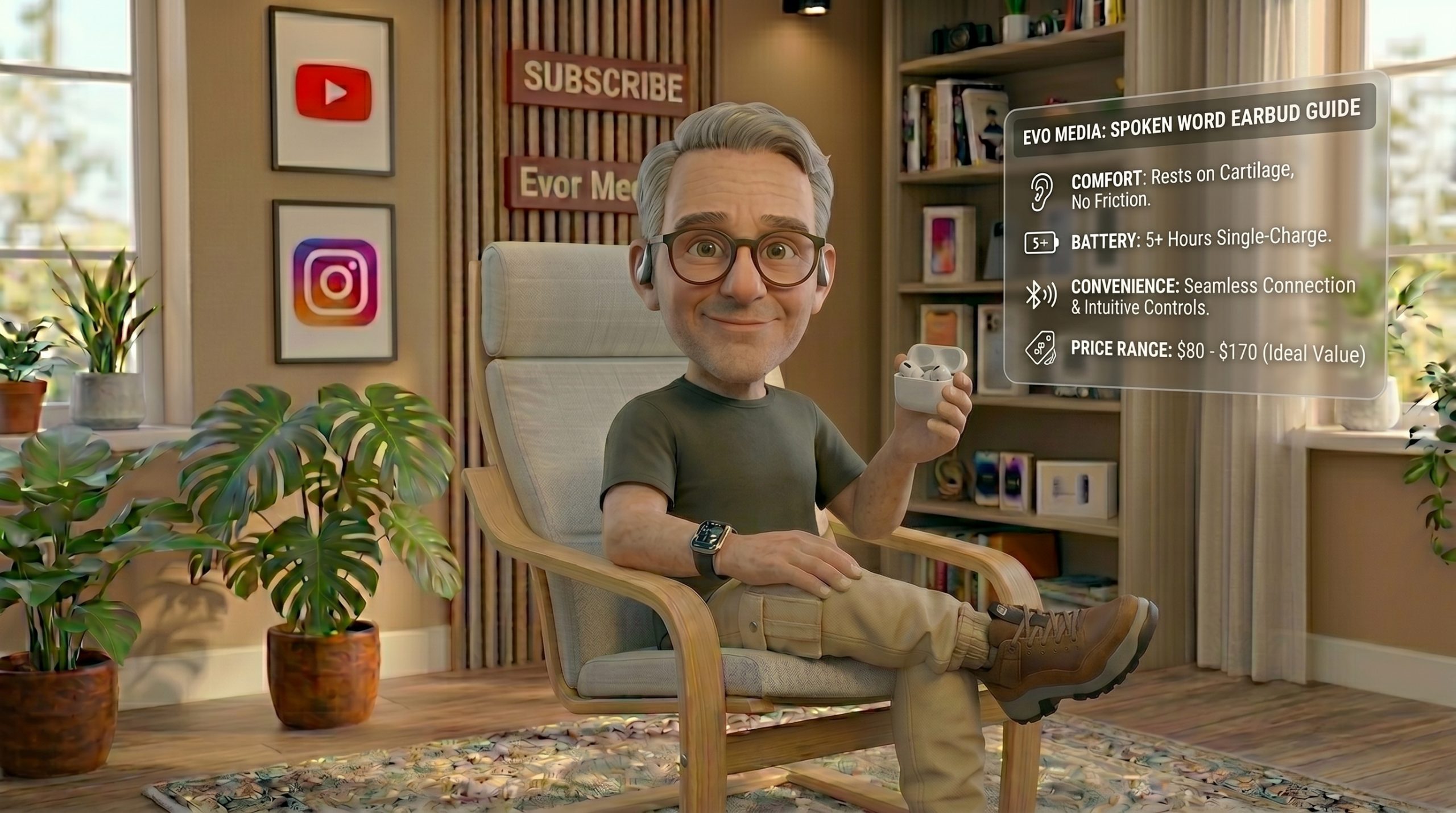
For spoken word entertainment, the decision comes down to just four factors: Comfort, Battery Life, Convenience, and Cost.

These four pillars are intertwined. You rarely get one without sacrificing another. But if you understand how they work together, you can avoid spending $300 on features you will never use. Let’s break it down.

Comfort: The Secret Is Frictionless FiT

When I listen to an audiobook, I am usually in for the long haul. I am not just listening for a three-minute song on the treadmill. I am listening while doing yard work, washing dishes, falling asleep on an airplane, or walking the dog for an hour. That means those little buds might be in my ears for four, five, or even six hours at a stretch.

Comfort is not a luxury for spoken word listeners. It is a necessity.

Here is the tricky part: every ear is unique. What feels like a fluffy cloud in my ear might feel like a torture device in yours. There is no universal “most comfortable earbud.” However, I have discovered a critical engineering principle that separates okay earbuds from great spoken-word earbuds.

The real secret is to avoid earbuds that rely on friction to stay in place.

Think about the standard rubber-tipped earbud that you twist into your ear canal. Those rely on friction the rubber pressing against the walls of your ear canal to hold tight. This has two major drawbacks for long-form listening:

  • Moisture destroys the hold. As you wear them, your ears generate moisture (sweat, oils). That moisture turns friction into a slip-and-slide. Suddenly, you are pushing the earbuds back in every five minutes.
  • Motion jars them loose. Chewing, walking, or smiling can break the friction seal.

What you actually want is an earbud that doesn’t rely on friction, but rather rests passively in the cartilage of your outer ear. This is the genius of the classic Apple AirPod design (the hard plastic “slip-fit” style). The earbud sits in the bowl of your ear, held gently by the tragus and anti-tragus cartilage. It isn’t jammed into the canal; it is resting in the architecture of your ear.

Does this design leak sound? Yes. Does it have less bass? Absolutely. But for spoken word, you don’t need a perfect seal. You need to forget you are wearing them for three hours. Look for “semi-in-ear” designs or open-fit designs if comfort is your absolute priority.

Battery Life: Don’t Let the Case Lie to You

Nothing ruins a great chapter twist like the robotic voice saying, “Battery low. Please recharge.”

When shopping for earbuds for spoken word, you need to look at two distinct numbers, and you need to know which one matters most:

  • Number One (The Buds): The hours of listening the earbuds will deliver on a single charge (the battery built into the earbud itself).
  • Number Two (The Case): The total hours including the charging case (the backup battery in your pocket).

Here is the mistake most people make: they see “24 hours of battery life” on the box and click “Buy.” But those 24 hours usually break down into 5 hours of buds + 19 hours from the case.

For spoken word listening, the single-charge number is king.

Why? Because you cannot hot-swap earbuds in the middle of a podcast. If you have a 10-hour flight and your buds only last 4 hours on a charge, you will be sitting in silence for 6 hours while they sit in the case recharging.

My hard rule: Never buy earbuds that offer less than 5 hours of continuous playback on a single charge. Ideally, look for 7 to 10 hours.

Using my AirPods as an example: they offer 5 hours of listening on a single charge and 24 hours total including the case (meaning the case can recharge them about five times). Five hours is the absolute floor. If you see a cool pair of $30 buds that only last 3 hours per charge, leave them on the shelf. They are not ready for the long-form listening lifestyle.

Convenience: The Ecosystem Tax (Worth Paying)

Convenience is the hardest factor to measure on a spec sheet. You cannot quantify “frustration.” But you know it when you feel it.

For spoken word, convenience breaks down into three specific behaviours:

A. How easily do they connect to my phone?

With music, you might tolerate a 15-second Bluetooth pairing dance because you are going to listen to an album you love. With spoken word, you often listen in short bursts—10 minutes here, 15 minutes there. If it takes 30 seconds to pair, you will stop listening. You want “instant on.” Open the case, put them in your ears, and hear the audio before the podcaster finishes their intro.

B. How reliable is the connection?

You cannot have dropouts. A dropped beat in a song is annoying. A dropped syllable in an audiobook mystery means you missed the killer’s name. You need a rock-solid connection that works through walls, pockets, and while your phone is in the backyard and you are in the kitchen.

C. How usable are the physical controls?

This is where many budget earbuds fail the spoken word test. You need to be able to Pause. Constantly.

If you are listening to a book and the delivery driver knocks, you need a tactile, reliable way to pause instantly. Capacitive touch controls that activate when you brush your hair? Terrible. Small buttons that require you to jam the bud into your ear? Worse.

The Ecosystem Effect:

Here is the inconvenient truth. If you are deeply embedded in an ecosystem (Apple, Samsung, Google), the earbuds made by that ecosystem usually offer the best convenience. Apple AirPods with an iPhone are magical. Samsung Galaxy Buds with a Galaxy phone are similarly seamless. The pairing is instant, the controls are integrated into the OS, and the reliability is top-tier.

You pay a “convenience tax” for this. It is often 50% more expensive than comparable generic hardware. But for spoken word listeners who value sanity over savings, it is frequently worth it.

Cost: The Law of Diminishing Returns

Finally, we get to the wallet. Cost is deeply personal, but the market has clear rules of thumb.

Generally speaking, you get what you pay for. A $15 pair of no-name earbuds from the gas station will fail on comfort, battery, and convenience. They will hurt your ears, die in 90 minutes, and refuse to pair on a Tuesday.

However, the spoken word listener has a massive advantage over the audiophile. You do not need to chase the high end:

  • The Sweet Spot ($50 – $80): This is your zone. At this price point, manufacturers have figured out how to make comfortable ergonomics, decent battery life (5-6 hours), and reliable Bluetooth 5.0+ connections. You will get a great sounding product for podcasts and books. Voices will be clear. Sibilance (that harsh ‘S’ sound) will be controlled. You will be happy.
  • The Danger Zone ($100 – $200): In this range, you are paying for better drivers, active noise cancellation (ANC), and advanced codecs (AAC, aptX). Do you need ANC for spoken word? Maybe if you commute on a subway. But often, ANC creates “ear pressure” that is uncomfortable for long sessions. You are paying for music features here.
  • The Luxury Zone ($200+): Beyond $200 (AirPods Pro 2, Sony WF-1000XM5, etc.), it becomes incredibly hard to identify the sound quality difference *for human speech*. You are paying for luxury materials, brand tax, and marginal improvements in bass response. You do not need this for a narrator reading a thriller.

My advice: Spend at least $50 to avoid the junk. Try very hard not to spend over $150. The return on investment for spoken word audio flatlines above that threshold.

The Final Verdict

The marketing departments want you to think you need a concert hall in your ears. You don’t. You need a comfortable chair for your brain.

When you walk into the store or scroll through Amazon, ignore the “dynamic range” and “sound stage” stats. Ask yourself four simple questions instead:

  1. Comfort: Do they rest in my cartilage, or do I have to jam them into my canals?
  2. Battery: Do they last at least 5 hours on a single charge?
  3. Convenience: Will they instantly pair with my phone every single time?
  4. Cost: Am I staying in the $50–$150 “sweet spot”?

Find the earbuds that check those boxes, and you will have a listening companion that lasts through every chapter, every commute, and every chore. And isn’t that the whole point of a good story?

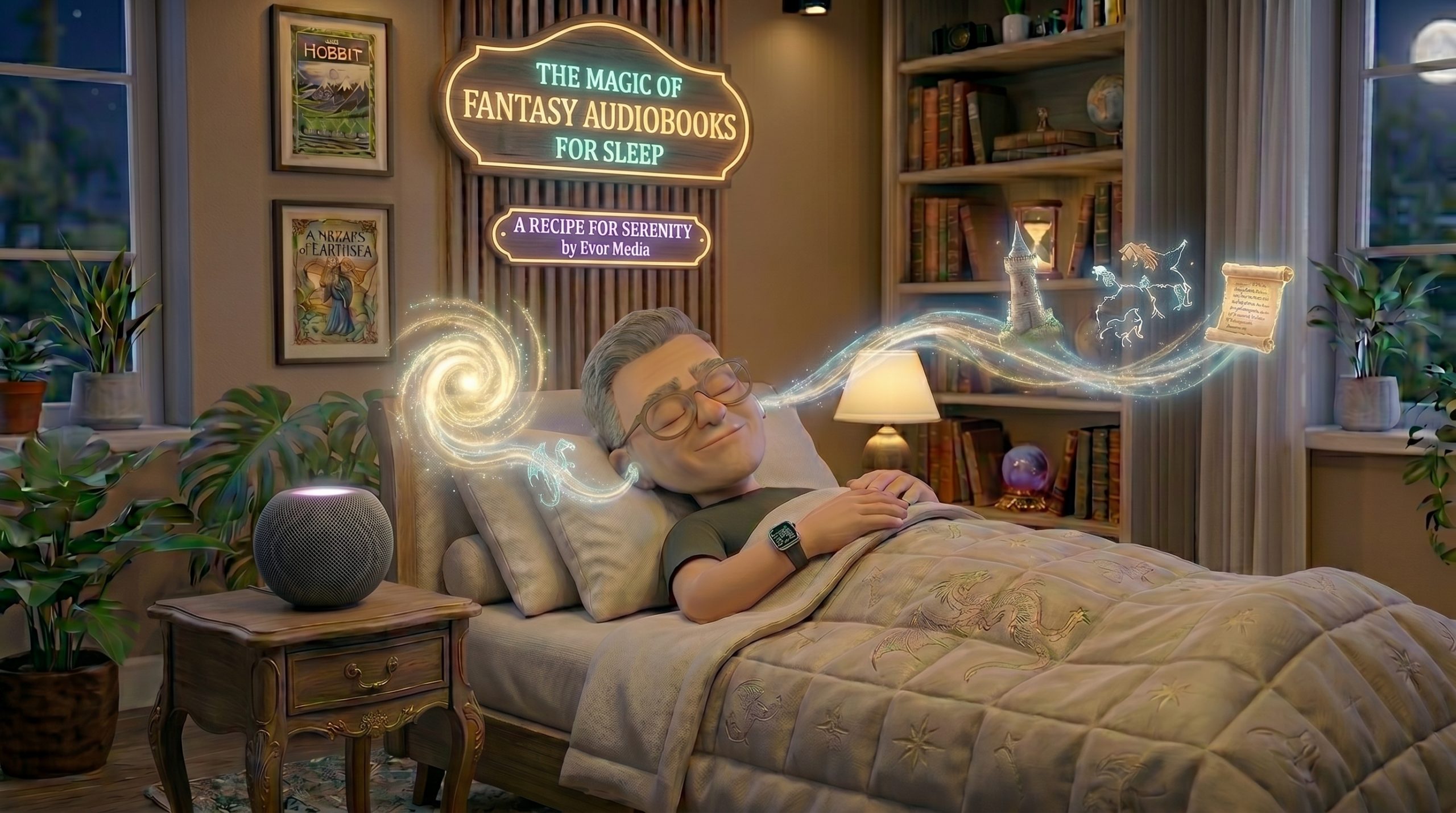
The Portal at your Bedside 

Why Falling Asleep to Fantasy Audiobooks is Pure Magic

There is a specific, alchemical moment that happens about twenty minutes after I press play. The heroes have just entered the haunted forest. The wizard is whispering a spell. The wind is picking up over the moors of a kingdom that doesn’t exist. And then nothing. The world dissolves. Not with a jolt, but with a sigh.

I fall asleep every single night to an audiobook. Not to white noise, not to guided meditations, and certainly not to the doom-scrolling silence of a dark phone screen. I fall asleep to fiction. Specifically, to fantasy.

For the uninitiated, this might sound counterintuitive. Isn’t sleep about quieting the mind? Don’t stories keep you up, turning pages until 3:00 AM? Usually, yes. But when you switch from reading with your eyes to listening with your ears, and when you choose the right genre, the bed becomes a magic carpet. Here is why sleeping with audiobooks, specifically fantasy fiction has turned my nights from a battlefield of anxiety into a magical experience.

The Paradox of the Plot

Let’s address the obvious objection first: “Doesn’t a gripping plot keep you awake?”

It can. If you are listening to a high-stakes thriller where a bomb is ticking down, or a mystery where the detective is about to unmask the killer, your adrenal glands will not cooperate with sleep. I learned this the hard way. But fantasy is different.

Fantasy operates on a different rhythm. Yes, there are battles and betrayals, but the texture of good fantasy is immersive rather than suspenseful. Fantasy relies on world-building. It lingers on the smell of rain in a cobblestone alley, the weight of a cloak, the specific way the light hits a crystal tower. These are not high-octane details; they are sedatives.

When you listen to a fantasy audiobook at a low volume, your brain isn’t waiting for a jump scare. It is processing a landscape. The narrative becomes a lullaby with a plot. You aren’t clinging to the edge of your seat you are sinking into the mattress of a fictional inn.

The Voice as a Vessel

There is a reason why we read bedtime stories to children. It is not about the plot of a Winnie the Pooh story; it is about the sound of safety. As adults, we forget that we still crave that.

My nightly ritual begins with selecting a narrator. I have my favourites, those with warm, slightly gravelly voices. British accents work particularly well (there is something about the formality that signals “story time”). I avoid narrators who are overly theatrical or who shout during action sequences. I look for the ones who read like they are telling a secret.

There is a unique intimacy to an audiobook. The narrator is speaking directly into your ear, usually through a high-quality microphone that captures every breath and inflection. In a world where we spend our days being yelled at by notifications, having a calm, steady voice tell you a story about dragons is a form of auditory therapy.

When that voice describes a character pulling up a blanket by a campfire, my body instinctively mimics the action. When the narrator lowers their volume to describe a character falling asleep in an elven grove, my own breathing syncs up. It is a form of mimicry. The characters rest, so I rest.

The Anti-Anxiety Shield

Here is the psychological truth that no one tells you about insomnia: silence is loud.

When you lie down in a perfectly dark, quiet room, your brain panics. It fills the void. It starts reviewing the embarrassing thing you said in 2014. It starts worrying about the email you forgot to send. It calculates your finances. Silence is an echo chamber for anxiety.

Sleeping with an audiobook solves this by providing what psychologists call a “cognitive anchor.” You cannot ruminate about your job review if you are trying to visualize a griffin soaring over a parapet. Your brain has a limited bandwidth. By feeding it a fictional world one with rules, maps, and magic you starve your anxiety of the attention it needs to survive.

I don’t listen to books I’ve never heard before. That is the rookie mistake. If I put on a brand new, highly anticipated sequel, my brain stays engaged because it wants to know what happens next. That is for the daytime.

For sleeping, I listen to re-reads. I listen to books I love so much that I know them by heart. I know that the hero survives the swamp. I know that the villain gets his fate that is fully deserved. Because I know the ending, my brain relaxes. There is no suspense, only comfort. It is the literary equivalent of a weighted blanket.

Currently, my rotation includes The Hobbit (narrated by Andy Serkis, though I skip the Gollum scenes because they are too intense), the Harry Potter series (Jim Dale’s voice is a sedative), and anything by Joe Abercrombie with Steven Pacey’s amazing narration.

The Ritual of the Sleep Setup

You cannot just throw earbuds in and hope for the best. Sleeping with audiobooks is a craft. Over the years, I have perfected the equipment.

First off, if you’re a side sleeper, you’ll want to get some sleep-specific earbuds. Regular earbuds can be a pain when you roll over, and you might end up losing them in bed, plus the battery won’t last the whole night. I’ve been using the Soundcore Sleep A30 by Anker, but remember, everyone’s ears are different, so take some time to look around and find the perfect sleep-specific earbuds for you.

Second, the sleep timer. This is non-negotiable. I set my timer for 30 or 45 minutes. I almost never make it to the end. In the morning, I rewind 15 minutes from where I fell asleep, and I listen to those same 15 minutes the next night. I have been “reading” the same 200-page book for three weeks, and it is glorious.

Third, volume control. The volume should be so low that you have to strain *just slightly* to hear it. That slight strain forces your brain to focus, which paradoxically relaxes your body. If it is too loud, it is intrusive. If it is too quiet, it becomes a whisper you chase into sleep.

Why Fantasy, Specifically?

I have tried other genres. Literary fiction is too depressing, I don’t want to hear about a crumbling marriage while I drift off. Non-fiction is too interesting, I will stay awake to learn about the Roman Empire.

Fantasy hits the sweet spot because it is alien enough to distract you, but emotional enough to comfort you.

I don’t want to fall asleep in my bedroom, I want to fall asleep in the Shire. I want to be on a ship sailing toward the Unknown. I want to be a mage in a tower, watching the stars through a telescope. Fantasy grants you permission to leave your body. And falling asleep is, after all, the ultimate act of leaving.

When you are struggling to sleep, you are hyper-aware of your own body. Your pillow is too hot. Your leg itches. Your heart is beating. Fantasy pulls the camera away from your physical self and puts it on a character who is sleeping in a hayloft after a long day of questing. You vicariously experience their exhaustion, their release.

The Morning After

The best part of this habit is not even the falling asleep; it is the waking up.

Because I fall asleep inside a story, I often wake up with the residue of that world in my head. I wake up wondering what the hobbits are having for second breakfast. I wake up feeling like I just traveled somewhere. It removes the shock of the alarm clock. Instead of jerking awake into the grey reality of a Tuesday morning, I surface slowly from a fog of magic.

Furthermore, because I fell asleep listening to a voice rather than scrolling TikTok or watching Netflix, which emits blue light that destroys melatonin, my sleep quality is noticeably better. I dream more vividly. I remember my dreams more often. I wake up feeling like my brain actually did the maintenance work it was supposed to do.

A Word of Caution

If you try this, be patient. The first few nights, you will stay up listening. That is fine. Let yourself get through the first few chapters at normal waking volume. Then, when you are ready to sleep, rewind to the beginning of the chapter and lower the volume. Turn on the sleep timer. Let the familiar words wash over you.

Do not use action-heavy books. Avoid battles. Avoid chase scenes. Avoid narrators who scream. You are looking for the travel portions of fantasy the walking through meadows, the sitting by fires, the descriptions of feasts, the quiet conversations in libraries.

The Final Chapter

I used to fear bedtime. I used to lie there, heart racing, watching the red numbers on the clock tick toward sunrise. I tried melatonin, breathing exercises, and the military method. Nothing worked until I realized that my brain didn’t need silence. It needed a different kind of noise.

It needed a story.

Now, when I turn out the light, I feel excitement, not dread. I get to go on an adventure, and then I get to fall asleep during it. I get to be the character who closes their eyes at the inn, knowing the wizard will keep watch.

If you struggle to sleep, if your mind races, if you feel lonely in the dark—try it. Download a fantasy audiobook you already love. Find a narrator with a voice like honey. Press play. Close your eyes. And let the magic carry you somewhere else.

Because the best bedtime story isn’t the one that ends with “The End.”

It’s the one you never finish.

Sweet dreams and may your dreams be filled with dragons.

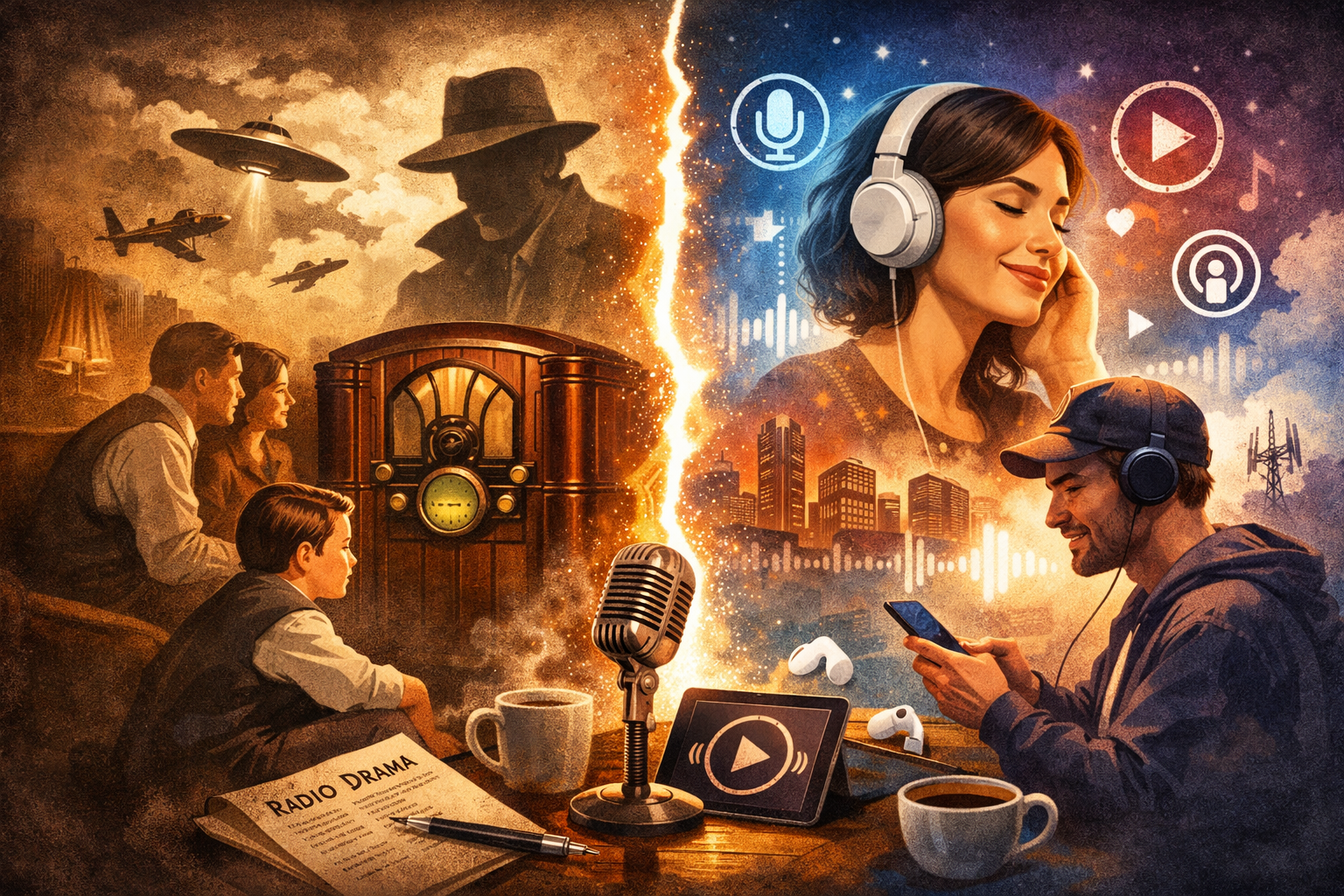
From Radio Dramas to Podcasts

What Changed…and What Didn’t

There was a time when families would gather around a radio, waiting for a story to begin

  • Not scrolling.
  • Not skipping.
  • Waiting.

In the 1930s and 40s, radio dramas weren’t just entertainment—they were events. Shows like The Shadow radio program and The War of the Worlds broadcast captured the imagination of millions. People sat together, listening closely, building entire worlds in their minds from nothing but sound.

Today, we live in what feels like a completely different universe. Podcasts stream on demand. Audiobooks follow us everywhere. Voices live in our ears through devices like Apple AirPods.

But when you strip away the technology, something surprising becomes clear:

  • A lot has changed.
  • And almost nothing has.

What Changed: Control, Convenience, and Choice

The biggest shift from radio dramas to podcasts is simple: control.

In the golden age of radio, you listened when the show aired. Miss it, and it was gone. That limitation created a kind of shared rhythm—entire cities tuned in at the same time.

Today, podcasts have flipped that entirely.

  • Listen anytime
  • Pause, rewind, skip
  • Choose from millions of shows

Platforms like Spotify and Apple Podcasts have made audio deeply personal. Your listening habits are no longer shaped by a broadcast schedule—they’re shaped by you (and, increasingly, by algorithms).

It’s better in almost every measurable way.

But it’s also different in ways that are harder to measure.

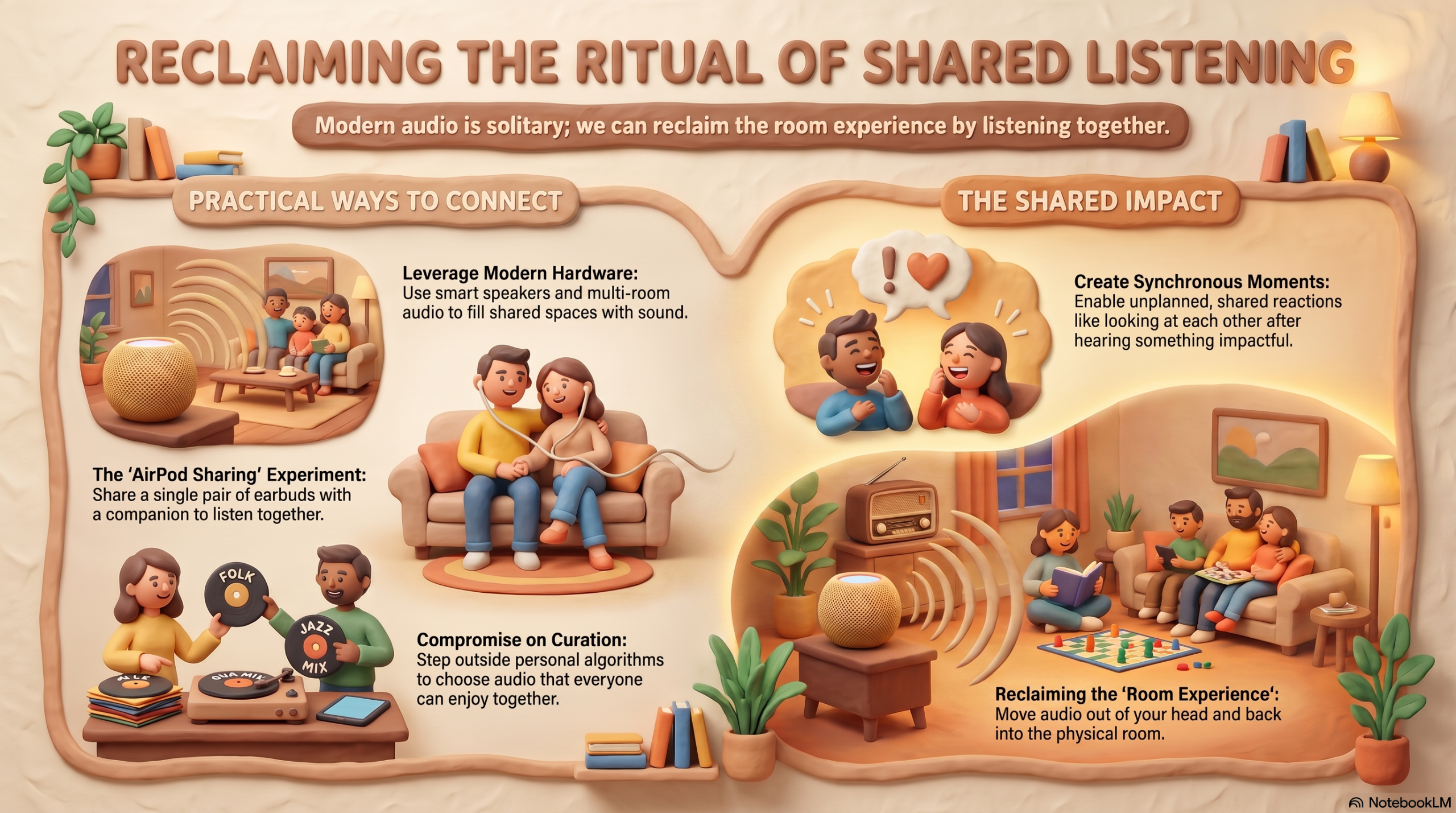
What Changed: From Shared Rooms to Personal Spaces

Radio was a room experience.

Podcasts are a headphone experience.

That shift—from speakers to earbuds—quietly transformed how we connect through audio. What was once communal is now individual. We’ve traded the living room for the inside of our own heads.

We don’t gather to listen anymore.

We listen alone—together, but separate.

And while that independence is powerful, it comes with a subtle cost: fewer shared moments.

What Didn’t Change: The Power of Voice

Despite all the technological change, the core of audio storytelling remains exactly the same…a voice, telling a story.

Whether it’s a 1940s announcer leaning into a microphone or a modern podcast host speaking into a USB mic, the connection is still deeply human. Audio has an intimacy that video often lacks.

There’s no screen to distract you.

No visuals to define things for you.

Just voice—and your imagination filling in the rest.

That hasn’t changed at all.

What Didn’t Change: Imagination Does the Heavy Lifting

One of the most powerful things about radio dramas was what they didn’t show you.

There were no visuals—only suggestion. A creaking door. Footsteps in the dark. A pause in someone’s voice…your mind did the rest.

Podcasts—especially narrative ones—still rely on that same magic. Even today, the best audio stories don’t overwhelm you with detail. They leave space.

Space for you to imagine…space for you to participate.

In a world dominated by screens, that feels almost radical.

The Middle Ground We’re Still Figuring Out

If radio was communal and podcasts are personal, we’re still trying to figure out what comes next.

We have the tools to bring shared listening back—smart speakers, voice assistants, multi-room audio. Devices like the 

Apple HomePod smart speaker can easily fill a room with sound.

But the habit isn’t there:

  • We’ve grown used to listening alone.
  • Curating our own tastes.
  • Rarely compromising on what we hear.

And yet, there’s something missing.

A Small Experiment in Shared Listening

My wife and I have stumbled into a small way of reclaiming that lost connection.

When we go for walks, we share a single pair of AirPods—she takes the right, I take the left—and we listen to the same podcast.

It’s a simple thing. Almost silly.

But it creates moments that feel surprisingly rare: both of us reacting at the same time, stopping mid-step, looking at each other after hearing something that lands.

That shared reaction—that unplanned, synchronous moment—is something radio listeners in the 1940s would have recognized instantly.

The Real Difference

So what really changed?

  • Not the storytelling.
  • Not the voice.
  • Not the imagination.

What changed is how we experience it together.

Radio made listening a collective ritual.
Podcasts made it a personal habit.

Neither is inherently better. But one of them brought people into the same moment—and the other lets us drift into our own.

Final Thoughts

We didn’t lose the magic of radio when podcasts arrived. In many ways, we expanded it.

We just redistributed it—from the room to the individual.

Maybe the next evolution of audio isn’t about better technology or smarter algorithms.

Maybe it’s about rediscovering something much older:

Listening, not just at the same time—
but together.

The Golden Age of Radio vs. The Golden Age of Audio:

What We’ve Lost (and How to Get It Back)

I’ve had a long-standing romance with old-time radio, especially the magic of the 1940s. Sometimes it feels like I was born in the wrong era. There’s something deeply compelling about the image of a family gathered around a beautiful wooden console radio, completely immersed in a shared story.

The Magic of 1940s Radio

In the 1940s, radio wasn’t just background noise, it was an event.

Families would gather around large console sets like the Zenith 12S471 floor console radio, tuning in to dramas, comedies, and news broadcasts. Each listener imagined the scenes differently, yet everyone experienced the same story at the same time. That balance, individual imagination paired with collective experience—was the true magic of the golden age of radio.

It was simple. It was shared. And it was powerful.

Today’s Golden Age of Audio

Fast forward to today, and we’re living in what could easily be called the golden age of audio. Podcasts, audiobooks, and streaming music are more accessible than ever. Devices like the Apple AirPods and Apple HomePod smart speaker have made listening effortless and ubiquitous.

But here’s the paradox: while access has improved, connection has diminished.

Wireless headphones have revolutionized how we consume audio, but they’ve also quietly isolated us. We’ve become a society of solo listeners, each in our own personalized audio bubble.

The Problem with Personalized Listening

The convenience of earbuds has shaped our habits in subtle ways:

  • We listen alone, even when we’re together
  • Algorithms replace shared discovery
  • Audio becomes individualized instead of communal

There was a time when discovering new music or shows meant listening with others, friends, family, even strangers. Today, algorithms are more efficient, but they lack the human element that made discovery meaningful.

A Small Rebellion: Sharing One Pair of Headphones

My wife and I have found a small way to push back against this trend.

When we go for walks, we could easily each put in our own headphones and listen to separate things. But we don’t.

Instead, she uses the right AirPod, and I use the left. We listen to the same podcast or audiobook, together.

It sounds trivial, but it changes everything.

We’ve had moments where we both stop walking at the exact same time, hearing a powerful “mic drop” moment, and just look at each other. No words needed. That shared reaction is something you simply don’t get when listening alone.

That’s the missing ingredient in today’s golden age of audio: shared experience.

Could Smart Speakers Bring It Back?

There’s hope.

Devices like smart speakers make it possible to recreate that communal listening experience. It’s not hard to imagine a modern version of a 1940s living room, family or friends gathered around, listening to an audio drama after dinner.

Maybe it’s a podcast. Maybe it’s an audiobook. Maybe it’s something entirely new.

The technology is here.

The habit is not.

When Radio Became Television

There’s an interesting parallel from history.

In the 1950s, as television emerged, many successful radio shows transitioned to the new medium. But something was lost in translation.

My father, who grew up in the 1940s, once told me about the disappointment of seeing his favorite radio characters on television. The faces on the screen didn’t match the ones he had imagined.

Radio invited participation. Television replaced it.

Why 1940 Was the Peak

If there was a peak moment for radio, it was likely around 1940.

Radio rose in the mid-1920s and began fading by the early 1950s as television took over. By the late 1940s, broadcasters were already shifting their focus away from radio. That makes 1940 a kind of sweet spot—when the medium was mature, widely adopted, and still culturally dominant.

It’s no coincidence that iconic radios like the Zenith 12S471 came from this era. They weren’t just appliances, they were the centrepiece of the home.

Recreating the Golden Age Today

Maybe I’m romanticizing the past. Probably.

But I can’t shake the vision of a near future where we reclaim some of what made that era special.

A quiet evening. A cup of tea or coffee. A room filled with people. And a story playing, not through isolated earbuds, but out loud, shared.

Maybe it’s through a modern speaker instead of a wooden console. Maybe the content is a podcast instead of a radio drama.

But the feeling?

That could be the same.

Final Thoughts

We didn’t lose the magic of audio—we just changed how we experience it.

The golden age of radio was about togetherness.
The golden age of audio is about choice.

The next evolution might be about finding a way to have both.

And maybe it starts with something as simple as sharing a single pair of headphones.