
It’s in the Room
The Loneliness of the Perfect Playlist
We are living through the era of the noise-canceled void. On any given city street or living room sofa, you see them: the white stems or leather-bound cups that signal a total withdrawal from the shared environment. We have become masters of the “headphone experience,” moving through life encased in private sonic bubbles fueled by hyper-personalized algorithms. While this grants us unprecedented control over our internal soundtracks, it has quietly dismantled the communal rituals that once bound us together. We have traded the messy, unpredictable joy of the “Shared Room” for the sterile isolation of individual curation. To find the soul of audio again, we must stop listening at each other and start listening with each other.
Your Smart Speaker is a Social Tool You’re Using Wrong
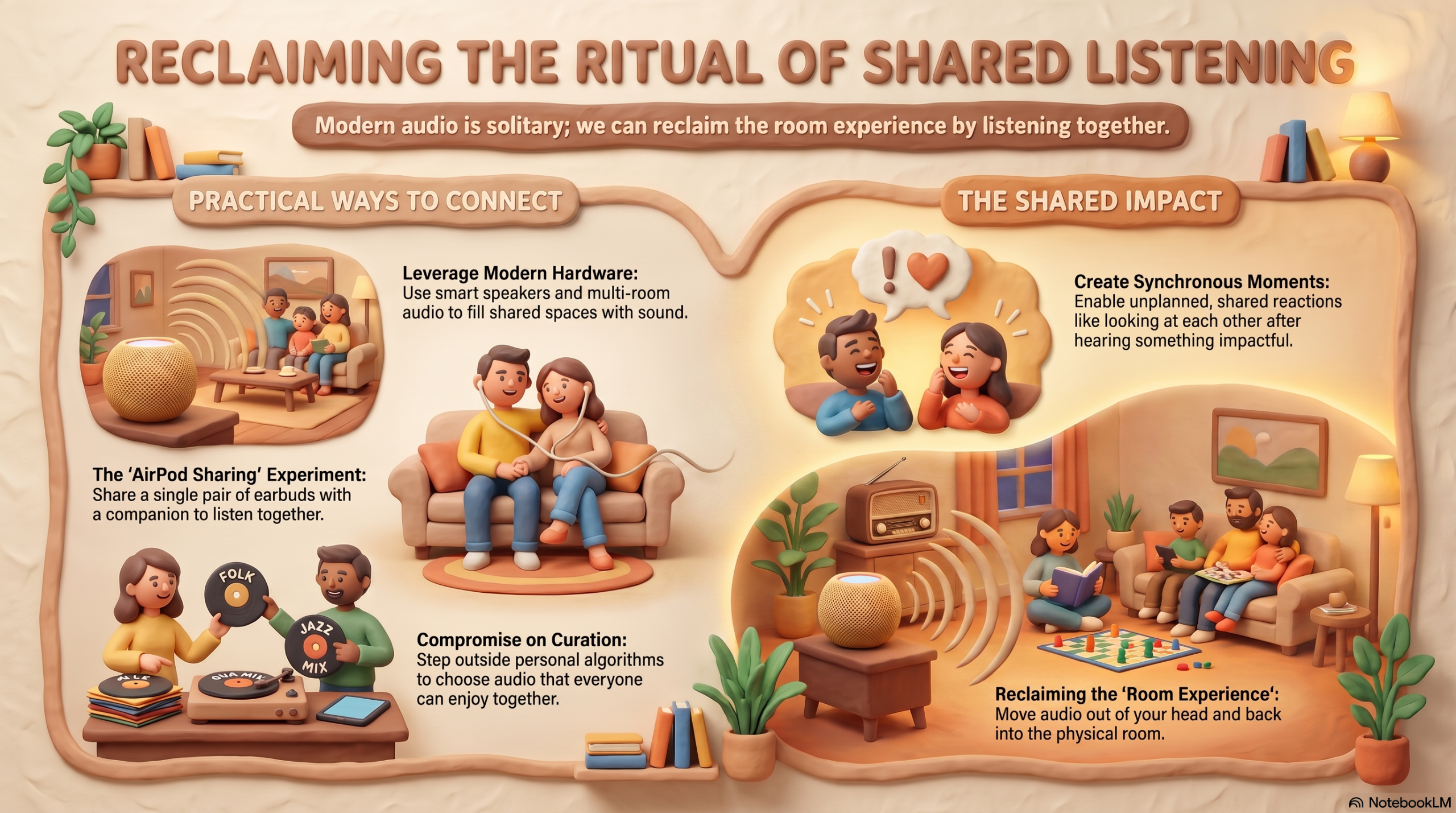
We have filled our homes with silicon-and-mesh altars to audio—the HomePods, the Alexas, the sophisticated multi-room arrays—yet we treat them like lonely monoliths. These devices are engineered to saturate a physical space, yet a strange psychological inertia keeps us from using them for their intended purpose.This disconnect stems from the “privatization of sound.” In the smartphone era, we have been conditioned to view audio as a private property rather than an invitation. We hesitate to play a podcast or a narrative over a speaker because we’ve forgotten how to negotiate shared space; we fear it will be an intrusion rather than a bridge. We treat a thousand-dollar room-filling system like a glorified personal headset, missing the opportunity to turn a house into a theater of shared stories.
The Radical Intimacy of Sharing an AirPod
Reclaiming the ritual of connection doesn’t always require a high-fidelity home theater; sometimes, it requires a radical act of low-tech vulnerability. Consider the “AirPod sharing” experiment. By splitting a single pair of earbuds—left for you, right for a companion—you effectively dismantle the digital wall between two people.This simple act transforms a private digital stream into a shared physical journey. Whether you are navigating a crowded sidewalk or sitting on a park bench, you are tethered to the same rhythm and the same narrative arc.”By giving one earbud to another person while walking or sitting together, you can listen to the same podcast or story at the exact same time .”
Hunting for the “Synchronous Moment”
There is a specific electricity in the “shared reaction” that defines the human experience. In the Golden Age of Radio, families didn’t just hear the news; they heard it together, their gasps and laughs mirroring one another in real-time. Modern technology has largely stripped away these “unplanned, synchronous moments,” replacing them with the “zombie-like” walk of two people on entirely different feeds.When you share a story in real-time, you witness the physical cues of connection: the sudden, shared freeze as a plot twist lands, the sharp intake of breath, or the spontaneous eye contact after an impactful statement. These are the moments where the digital divide vanishes. This physical and emotional synchronization enriches the content in a way that an solo listen—no matter how high the bitrate—never could.
To Connect, You Must Kill Your Algorithm
The greatest obstacle to this new (old) way of listening is our own ego. Platforms like Spotify and Apple Podcasts are designed to keep us “inside our own heads” by catering to our most specific, hyper-individualized whims. To move into the room, you must be willing to kill your algorithm.Communal listening requires the “sacrifice” of individual curation. It demands a compromise—choosing a program not because it matches your personal data profile, but because it serves the collective. By stepping away from the personalized feed, we stop being consumers of data and start being participants in a shared culture.”The future of audio isn’t necessarily about better algorithms or technology, but about ‘listening together again’ to rediscover the human connection found in a shared story.”
Conclusion: Moving Out of Our Own Heads
Reclaiming the ritual of communal listening is about more than just entertainment; it is an essential act of bridging the digital silos we’ve built around ourselves. By transitioning from the isolated “headphone experience” back to the “room experience,” we transform audio from a solitary distraction into a catalyst for genuine human connection.When was the last time you truly shared a story—breath for breath, moment for moment—with someone else in the same room?