Why Listening Is the Ultimate Power Move for the Modern Reader
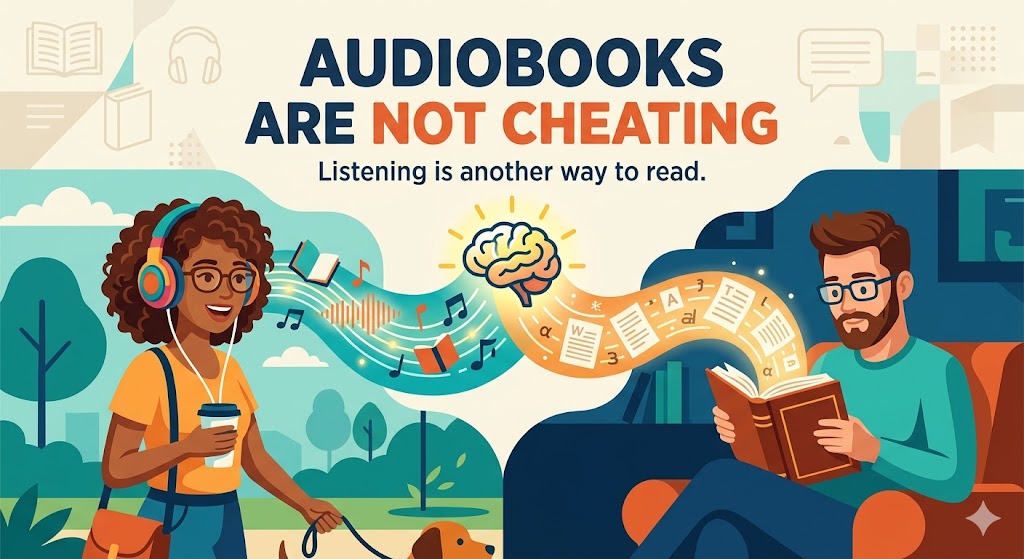
There is a quiet war being waged in the corners of book clubs, Twitter threads, and cozy coffee shop conversations. On one side, you have the Written Word Purists, those who believe that the only true way to enter a story is through the physical act of scanning ink on paper with your own two eyes. On the other side, you have the Listeners: the joggers, the commuters, the dishwashers, and the multitaskers who have discovered a secret portal to infinite worlds via their earbuds.
I am here to plant a flag firmly in the dirt of the second camp.
For years, I sat on the fence. I felt a twinge of guilt every time I clicked “play” on Audible instead of picking up the physical copy on my nightstand. I wondered if I was taking a shortcut. I wondered if I was, as the purists might whisper, cheating.
But a few months ago, I had a conversation that broke that fence into splinters. Sitting with a group of self-described “written word purists,” I watched them pat each other on the back for reading two or three books in five months. Meanwhile, I had quietly consumed six audiobooks in the same timeframe—and remembered almost all of it.
Let’s settle this once and for all. Audiobooks are not cheating. They are evolution. And here is why.
The Vocabulary Trap: Reading vs. Consuming
Let’s get one thing out of the way immediately, because I believe in honesty. The purists are technically correct about one single point.
If you listen to an audiobook, you did not read it.
I don’t disagree with that. Reading is a specific mechanical and neurological process involving visual decoding. If I listen to Dune while driving to work, I cannot honestly tell you I read Dune. I listened to it.
But here is the massive, glaring flaw in that argument: Does it matter?
The goal was never the act of moving your eyeballs across a page. The goal was never the smell of the paper or the sound of the page turn (as lovely as those things are). The goal is consumption.
You want to consume the information. You want to absorb the narrative. You want to feel the emotion of the prose and understand the arc of the characters. The book is a vessel; the story is the cargo. Whether you haul that cargo onto the shore of your brain via a rowboat (paper), a speedboat (e-reader), or a helicopter (audiobook), you still have the cargo.
To argue that listening isn’t valid is to argue that blindness is a barrier to literature. It is ableist nonsense. If a person who is visually impaired listens to War and Peace, are they less cultured than a sighted person who skimmed it? Absolutely not. They consumed the same art. End of discussion.
The Retention Myth: You Just Haven’t Learned the Skill Yet
The most common pushback I hear (and the one I heard from the purists at that coffee shop) is this: You don’t retain as much when you listen. Your mind wanders.”
At first glance, this seems reasonable. When you read a physical book, your hands are occupied. Your eyes are locked in. It is a command performance for your attention. When you listen to an audiobook, you might be folding laundry, walking the dog, or scrolling your phone (don’t scroll your phone—that is actually a problem).
But let’s dissect this claim. Is retention lower for listening, or is retention lower for distracted listening?
I would argue that listening to an audiobook is a learned skill, just like traditional reading.
Do you remember learning to read as a child? You didn’t pick up The Hobbit at age four. You started with See Spot Run. Your eyes darted around the page. You lost your place constantly. You had to sound out every third letter. Your mind wandered to the TV in the other room. It took you years of practice to develop the muscle memory to keep your eyes tracking in a straight line for four hundred pages.
Why do we expect listening to be perfect out of the gate?
Auditory comprehension is a different neural pathway. It requires training. You have to learn how to let the narrator’s voice build the world for you without your internal monologue interrupting. You have to learn how to rewind thirty seconds when you realize you were thinking about what to make for dinner.
Most people haven’t honed their listening skill because they gave up after one distracted session. They tried listening while driving in a thunderstorm or while cooking a complex recipe and decided, “See? I can’t focus.”
But here is the secret: When you do hone that skill, something magical happens. You begin to retain more than a visual reader retains. Why? Because sound carries emotional weight. The tone, the pause, the inflection, the accent these are data points that do not exist on the printed page. A good narrator adds a layer of meaning that the written word alone cannot convey.
The Math Doesn’t Lie (May was a wake-up call)
Let me tell you about that afternoon in May that changed my perspective forever.
I was sitting with a group of lovely, intelligent, well-read people. They were discussing their “TBR” (To Be Read) piles with the kind of solemn reverence usually reserved for religious texts. Then the conversation turned competitive.
“How many books have you read so far this year?” someone asked.
It was May. Five months into the year. Twenty weeks.
One person proudly said, “Three.”
Another said, “Two and a half.”
The most voracious reader in the group sheepishly admitted to “almost four.”
I sat there, stirring my coffee, doing the math in my head. Between January and May, I had listened to six audiobooks. Six. Two biographies, one dense historical non-fiction, two literary fiction novels, and one massive 22-hour fantasy epic.
Even if we concede just for the sake of argument—that my retention was only 60% of their traditional reading retention (which I do not believe, but let’s pretend), let’s look at the sheer volume of consumption.
The Purist Average: ~2.5 books at 95% retention = 2.375 books worth of story consumed.
Me: 6 books at 60% retention = 3.6 books worth of story consumed.
I consumed more than the fastest reader in the room, even at a massive hypothetical disadvantage.
But here is the kicker: my retention isn’t 60%. For narrative fiction, my retention for audiobooks is easily 85-90% because I have practiced. That means I consumed roughly 5.4 books of value. I lapped them. And I didn’t even have to sit at a desk to do it.
The Superpower of the Audiobook: Dead Time
This is the point where the purists usually get angry. They argue that reading is a sacred ritual that requires a dedicated chair, a cup of tea, and the absence of distraction. And look, that is beautiful. I love a Sunday afternoon with a physical book.
But most of us do not have Sunday afternoons. We have commutes. We have gym sessions. We have dishes. We have laundry. We have yard work. We have hour-long waits at the doctor’s office.
The superpower of the audiobook is the ability to turn dead time into story time:
- Commuting: I turned a soul-crushing 45-minute highway crawl into 45 minutes of Project Hail Mary. I actually started looking forward to traffic.
- Gym: While running on a treadmill, I listened to Born to Run. It felt like the narrator was coaching me.
- Chores: I cleaned my entire garage while listening to The Sellout. I didn’t even notice the dust.
Physical readers have to make time to read. Audiobook listeners simply reclaim time that was already lost.
That isn’t cheating. That is optimization.
The Enhancement Factor: When Listening Beats Reading
Here is the controversial part of this blog post. I am going to say something that might get me banned from certain literary circles.
Sometimes, listening is better than reading.
I know. Blasphemy. But hear me out.
When you read a physical book, you are limited to your own internal narrator. That voice in your head is fine, but it is one note. It is your voice. It doesn’t have range.
When you listen to an audiobook, you get a performance. You get:
- Authentic accents: I tried to read Shuggie Bain in my head. It didn’t work because I don’t know Scottish dialect. I listened to the audiobook, and suddenly the rhythm, the slang, and the music of the language exploded off the recording.
- Multiple voices: A great narrator like Michael Kramer or Kate Reading gives every character a distinct vocal identity. You never lose track of who is speaking.
- Comedy timing: Comedians reading their own memoirs (Trevor Noah’s Born a Crime, I’m looking at you) is a genre unto itself. The jokes land harder because the author knows exactly where to pause.
- Poetry: Hearing a poem read aloud by the poet reveals the meter in a way your eyes cannot decode.
To refuse to listen to an audiobook because you think it is “lesser” is like refusing to watch a Shakespeare play because you prefer to read the script in a dark room. You are literally missing half the art.
Addressing the “Wandering Mind” Honestly
I won’t be dishonest. Audiobooks require discipline. You cannot hit play and then scroll Instagram. That isn’t the medium’s fault; that is user error.
If your mind wanders during an audiobook, do the same thing you do when your eyes wander on a physical page: go back.
Every reader, whether visual or auditory, has to “rewind” their brain when they zone out. On a physical page, you glance up and find your spot. On an audiobook, you hit the “back 30 seconds” button. It is the exact same mechanic.
The difference is that we accept mind-wandering as normal for reading, but we treat it as a failure for listening. That is a double standard.
If you find your mind wandering while listening, you haven’t failed. You just need to practice. Start with easier books. Listen to a thriller or a YA novel before you tackle Infinite Jest. Turn off your phone notifications. Do a single, repetitive task (folding laundry, walking, driving on a familiar road) rather than a complex one.
Within a month, you will find your audio stamina has doubled.
The Verdict: Shut Up and Press Play
So, to the written word purists who look down their noses at my earbuds: I see you. I respect your love for the tactile experience. I have a shelf full of beautiful hardcovers too.
But you are wrong.
You are wrong to gate keep stories. You are wrong to imply that someone who listened to *Middlemarch* while running a marathon is less intelligent than someone who read it while sitting on a couch. You are wrong about retention rates, and you are definitely wrong about the value of performance.
And between you and me? While you were bragging about your two books in five months, I was consuming six. I was living six different lives. I was crying in my car over character deaths. I was laughing out loud on the subway. I was learning history while mowing the lawn.
That isn’t cheating. That is winning the game of life.
So go ahead. Keep your pristine TBR pile. Keep your highlighters and your page corners. I will be over here, pressing play, folding my laundry, and absorbing another story.
Just don’t ask me if I read it. Ask me if I experienced it.
The answer is always yes.
Final Thought: If you are currently listening to this blog post via a text-to-speech reader, you have consumed every word. And I am proud of you. Now go queue up your next book.