Audiobooks Are Not Cheating

Why Listening Is the Ultimate Power Move for the Modern Reader
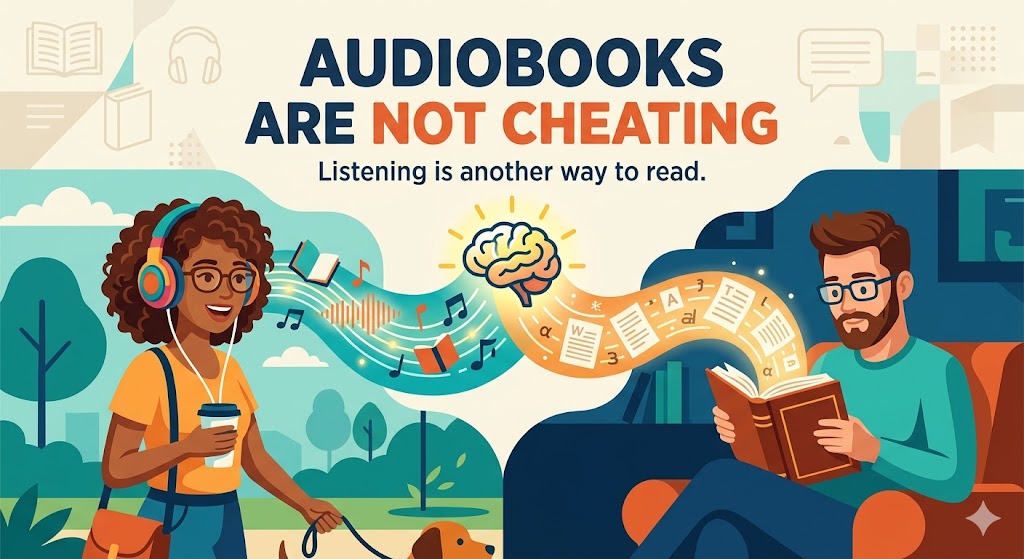
There is a quiet war being waged in the corners of book clubs, Twitter threads, and cozy coffee shop conversations. On one side, you have the Written Word Purists, those who believe that the only true way to enter a story is through the physical act of scanning ink on paper with your own two eyes. On the other side, you have the Listeners: the joggers, the commuters, the dishwashers, and the multitaskers who have discovered a secret portal to infinite worlds via their earbuds.

I am here to plant a flag firmly in the dirt of the second camp.

For years, I sat on the fence. I felt a twinge of guilt every time I clicked “play” on Audible instead of picking up the physical copy on my nightstand. I wondered if I was taking a shortcut. I wondered if I was, as the purists might whisper, cheating.

But a few months ago, I had a conversation that broke that fence into splinters. Sitting with a group of self-described “written word purists,” I watched them pat each other on the back for reading two or three books in five months. Meanwhile, I had quietly consumed six audiobooks in the same timeframe—and remembered almost all of it.

Let’s settle this once and for all. Audiobooks are not cheating. They are evolution. And here is why.

The Vocabulary Trap: Reading vs. Consuming

Let’s get one thing out of the way immediately, because I believe in honesty. The purists are technically correct about one single point.

If you listen to an audiobook, you did not read it.

I don’t disagree with that. Reading is a specific mechanical and neurological process involving visual decoding. If I listen to Dune while driving to work, I cannot honestly tell you I read Dune. I listened to it.

But here is the massive, glaring flaw in that argument: Does it matter?

The goal was never the act of moving your eyeballs across a page. The goal was never the smell of the paper or the sound of the page turn (as lovely as those things are). The goal is consumption.

You want to consume the information. You want to absorb the narrative. You want to feel the emotion of the prose and understand the arc of the characters. The book is a vessel; the story is the cargo. Whether you haul that cargo onto the shore of your brain via a rowboat (paper), a speedboat (e-reader), or a helicopter (audiobook), you still have the cargo.

To argue that listening isn’t valid is to argue that blindness is a barrier to literature. It is ableist nonsense. If a person who is visually impaired listens to War and Peace, are they less cultured than a sighted person who skimmed it? Absolutely not. They consumed the same art. End of discussion.

The Retention Myth: You Just Haven’t Learned the Skill Yet

The most common pushback I hear (and the one I heard from the purists at that coffee shop) is this: You don’t retain as much when you listen. Your mind wanders.”

At first glance, this seems reasonable. When you read a physical book, your hands are occupied. Your eyes are locked in. It is a command performance for your attention. When you listen to an audiobook, you might be folding laundry, walking the dog, or scrolling your phone (don’t scroll your phone—that is actually a problem).

But let’s dissect this claim. Is retention lower for listening, or is retention lower for distracted listening?

I would argue that listening to an audiobook is a learned skill, just like traditional reading.

Do you remember learning to read as a child? You didn’t pick up The Hobbit at age four. You started with See Spot Run. Your eyes darted around the page. You lost your place constantly. You had to sound out every third letter. Your mind wandered to the TV in the other room. It took you years of practice to develop the muscle memory to keep your eyes tracking in a straight line for four hundred pages.

Why do we expect listening to be perfect out of the gate?

Auditory comprehension is a different neural pathway. It requires training. You have to learn how to let the narrator’s voice build the world for you without your internal monologue interrupting. You have to learn how to rewind thirty seconds when you realize you were thinking about what to make for dinner.

Most people haven’t honed their listening skill because they gave up after one distracted session. They tried listening while driving in a thunderstorm or while cooking a complex recipe and decided, “See? I can’t focus.”

But here is the secret: When you do hone that skill, something magical happens. You begin to retain more than a visual reader retains. Why? Because sound carries emotional weight. The tone, the pause, the inflection, the accent these are data points that do not exist on the printed page. A good narrator adds a layer of meaning that the written word alone cannot convey.

The Math Doesn’t Lie (May was a wake-up call)

Let me tell you about that afternoon in May that changed my perspective forever.

I was sitting with a group of lovely, intelligent, well-read people. They were discussing their “TBR” (To Be Read) piles with the kind of solemn reverence usually reserved for religious texts. Then the conversation turned competitive.

“How many books have you read so far this year?” someone asked.

It was May. Five months into the year. Twenty weeks.

One person proudly said, “Three.”

Another said, “Two and a half.”

The most voracious reader in the group sheepishly admitted to “almost four.”

I sat there, stirring my coffee, doing the math in my head. Between January and May, I had listened to six audiobooks. Six. Two biographies, one dense historical non-fiction, two literary fiction novels, and one massive 22-hour fantasy epic.

Even if we concede just for the sake of argument—that my retention was only 60% of their traditional reading retention (which I do not believe, but let’s pretend), let’s look at the sheer volume of consumption.

The Purist Average: ~2.5 books at 95% retention = 2.375 books worth of story consumed.

Me: 6 books at 60% retention = 3.6 books worth of story consumed.

I consumed more than the fastest reader in the room, even at a massive hypothetical disadvantage.

But here is the kicker: my retention isn’t 60%. For narrative fiction, my retention for audiobooks is easily 85-90% because I have practiced. That means I consumed roughly 5.4 books of value. I lapped them. And I didn’t even have to sit at a desk to do it.

The Superpower of the Audiobook: Dead Time

This is the point where the purists usually get angry. They argue that reading is a sacred ritual that requires a dedicated chair, a cup of tea, and the absence of distraction. And look, that is beautiful. I love a Sunday afternoon with a physical book.

But most of us do not have Sunday afternoons. We have commutes. We have gym sessions. We have dishes. We have laundry. We have yard work. We have hour-long waits at the doctor’s office.

The superpower of the audiobook is the ability to turn dead time into story time:

  • Commuting: I turned a soul-crushing 45-minute highway crawl into 45 minutes of Project Hail Mary. I actually started looking forward to traffic.
  • Gym: While running on a treadmill, I listened to Born to Run. It felt like the narrator was coaching me.
  • Chores: I cleaned my entire garage while listening to The Sellout. I didn’t even notice the dust.

Physical readers have to make time to read. Audiobook listeners simply reclaim time that was already lost.

That isn’t cheating. That is optimization.

The Enhancement Factor: When Listening Beats Reading

Here is the controversial part of this blog post. I am going to say something that might get me banned from certain literary circles.

Sometimes, listening is better than reading.

I know. Blasphemy. But hear me out.

When you read a physical book, you are limited to your own internal narrator. That voice in your head is fine, but it is one note. It is your voice. It doesn’t have range.

When you listen to an audiobook, you get a performance. You get:

  • Authentic accents: I tried to read Shuggie Bain in my head. It didn’t work because I don’t know Scottish dialect. I listened to the audiobook, and suddenly the rhythm, the slang, and the music of the language exploded off the recording.
  • Multiple voices: A great narrator like Michael Kramer or Kate Reading gives every character a distinct vocal identity. You never lose track of who is speaking.
  • Comedy timing: Comedians reading their own memoirs (Trevor Noah’s Born a Crime, I’m looking at you) is a genre unto itself. The jokes land harder because the author knows exactly where to pause.
  • Poetry: Hearing a poem read aloud by the poet reveals the meter in a way your eyes cannot decode.

To refuse to listen to an audiobook because you think it is “lesser” is like refusing to watch a Shakespeare play because you prefer to read the script in a dark room. You are literally missing half the art.

Addressing the “Wandering Mind” Honestly

I won’t be dishonest. Audiobooks require discipline. You cannot hit play and then scroll Instagram. That isn’t the medium’s fault; that is user error.

If your mind wanders during an audiobook, do the same thing you do when your eyes wander on a physical page: go back.

Every reader, whether visual or auditory, has to “rewind” their brain when they zone out. On a physical page, you glance up and find your spot. On an audiobook, you hit the “back 30 seconds” button. It is the exact same mechanic.

The difference is that we accept mind-wandering as normal for reading, but we treat it as a failure for listening. That is a double standard.

If you find your mind wandering while listening, you haven’t failed. You just need to practice. Start with easier books. Listen to a thriller or a YA novel before you tackle Infinite Jest. Turn off your phone notifications. Do a single, repetitive task (folding laundry, walking, driving on a familiar road) rather than a complex one.

Within a month, you will find your audio stamina has doubled.

The Verdict: Shut Up and Press Play

So, to the written word purists who look down their noses at my earbuds: I see you. I respect your love for the tactile experience. I have a shelf full of beautiful hardcovers too.

But you are wrong.

You are wrong to gate keep stories. You are wrong to imply that someone who listened to *Middlemarch* while running a marathon is less intelligent than someone who read it while sitting on a couch. You are wrong about retention rates, and you are definitely wrong about the value of performance.

And between you and me? While you were bragging about your two books in five months, I was consuming six. I was living six different lives. I was crying in my car over character deaths. I was laughing out loud on the subway. I was learning history while mowing the lawn.

That isn’t cheating. That is winning the game of life.

So go ahead. Keep your pristine TBR pile. Keep your highlighters and your page corners. I will be over here, pressing play, folding my laundry, and absorbing another story.

Just don’t ask me if I read it. Ask me if I experienced it.

The answer is always yes.

Final Thought: If you are currently listening to this blog post via a text-to-speech reader, you have consumed every word. And I am proud of you. Now go queue up your next book.
How to Choose Earbuds for Audiobooks & Podcasts 

Without Falling for Music Marketing

If you have spent even five minutes shopping for earbuds online, you have likely been buried under an avalanche of marketing jargon. Words like “sound stage,” “dynamic range,” “pristine treble,” and “punchy bass” are splashed across every box and product page.

But here is a hard truth that the audio industry doesn’t want you to hear: Most of that doesn’t matter for spoken word audio.

If you primarily listen to audiobooks, podcasts, lectures, or news commentary, you are navigating a very different buying landscape than a hardcore music fan. When you are listening to a narrator tell a story for six hours straight, you don’t need to feel the kick drum in your chest. You don’t need to hear the second violinist breathing. You need clarity, endurance, and sanity.

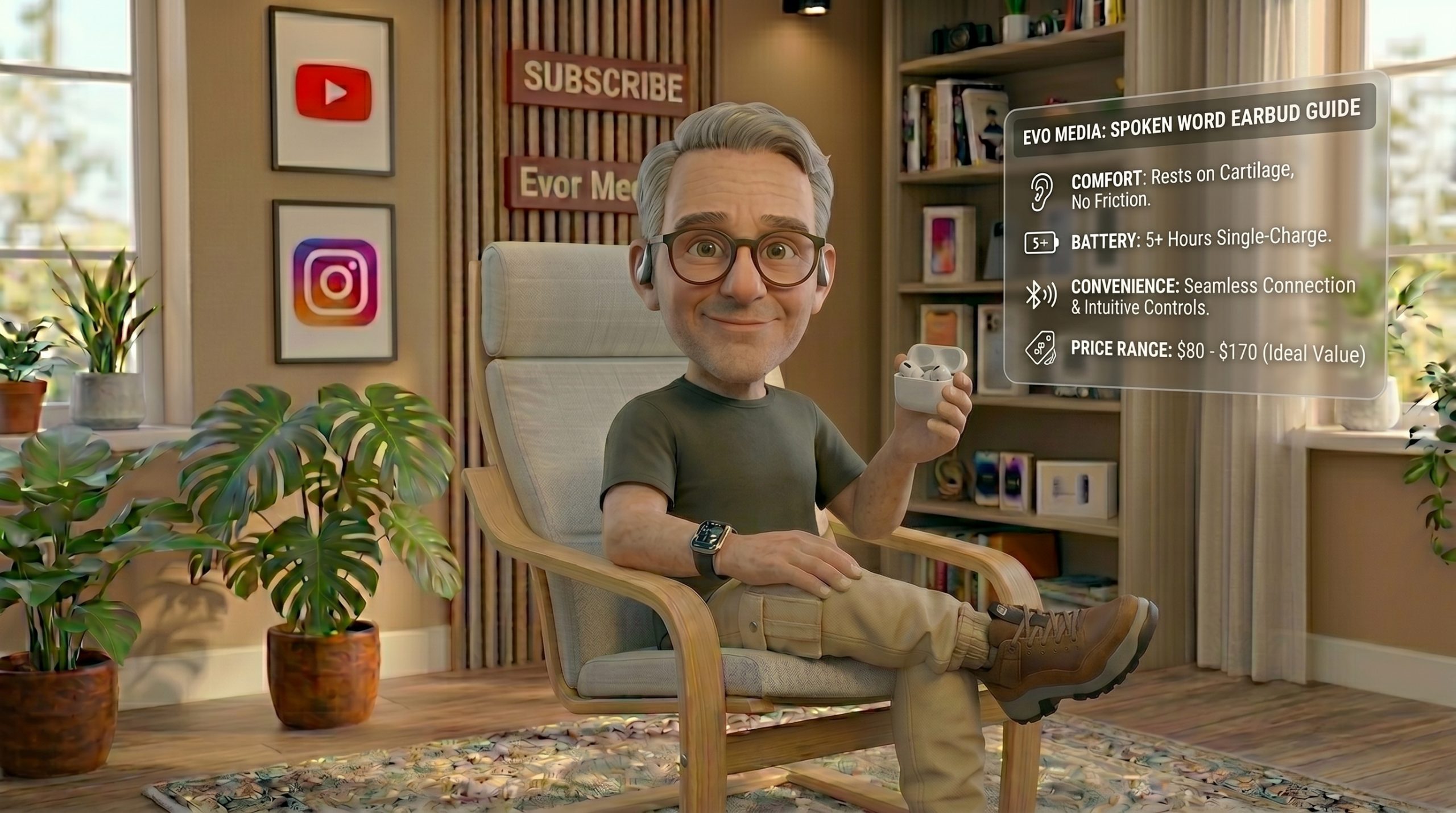
For spoken word entertainment, the decision comes down to just four factors: Comfort, Battery Life, Convenience, and Cost.

These four pillars are intertwined. You rarely get one without sacrificing another. But if you understand how they work together, you can avoid spending $300 on features you will never use. Let’s break it down.

Comfort: The Secret Is Frictionless FiT

When I listen to an audiobook, I am usually in for the long haul. I am not just listening for a three-minute song on the treadmill. I am listening while doing yard work, washing dishes, falling asleep on an airplane, or walking the dog for an hour. That means those little buds might be in my ears for four, five, or even six hours at a stretch.

Comfort is not a luxury for spoken word listeners. It is a necessity.

Here is the tricky part: every ear is unique. What feels like a fluffy cloud in my ear might feel like a torture device in yours. There is no universal “most comfortable earbud.” However, I have discovered a critical engineering principle that separates okay earbuds from great spoken-word earbuds.

The real secret is to avoid earbuds that rely on friction to stay in place.

Think about the standard rubber-tipped earbud that you twist into your ear canal. Those rely on friction the rubber pressing against the walls of your ear canal to hold tight. This has two major drawbacks for long-form listening:

  • Moisture destroys the hold. As you wear them, your ears generate moisture (sweat, oils). That moisture turns friction into a slip-and-slide. Suddenly, you are pushing the earbuds back in every five minutes.
  • Motion jars them loose. Chewing, walking, or smiling can break the friction seal.

What you actually want is an earbud that doesn’t rely on friction, but rather rests passively in the cartilage of your outer ear. This is the genius of the classic Apple AirPod design (the hard plastic “slip-fit” style). The earbud sits in the bowl of your ear, held gently by the tragus and anti-tragus cartilage. It isn’t jammed into the canal; it is resting in the architecture of your ear.

Does this design leak sound? Yes. Does it have less bass? Absolutely. But for spoken word, you don’t need a perfect seal. You need to forget you are wearing them for three hours. Look for “semi-in-ear” designs or open-fit designs if comfort is your absolute priority.

Battery Life: Don’t Let the Case Lie to You

Nothing ruins a great chapter twist like the robotic voice saying, “Battery low. Please recharge.”

When shopping for earbuds for spoken word, you need to look at two distinct numbers, and you need to know which one matters most:

  • Number One (The Buds): The hours of listening the earbuds will deliver on a single charge (the battery built into the earbud itself).
  • Number Two (The Case): The total hours including the charging case (the backup battery in your pocket).

Here is the mistake most people make: they see “24 hours of battery life” on the box and click “Buy.” But those 24 hours usually break down into 5 hours of buds + 19 hours from the case.

For spoken word listening, the single-charge number is king.

Why? Because you cannot hot-swap earbuds in the middle of a podcast. If you have a 10-hour flight and your buds only last 4 hours on a charge, you will be sitting in silence for 6 hours while they sit in the case recharging.

My hard rule: Never buy earbuds that offer less than 5 hours of continuous playback on a single charge. Ideally, look for 7 to 10 hours.

Using my AirPods as an example: they offer 5 hours of listening on a single charge and 24 hours total including the case (meaning the case can recharge them about five times). Five hours is the absolute floor. If you see a cool pair of $30 buds that only last 3 hours per charge, leave them on the shelf. They are not ready for the long-form listening lifestyle.

Convenience: The Ecosystem Tax (Worth Paying)

Convenience is the hardest factor to measure on a spec sheet. You cannot quantify “frustration.” But you know it when you feel it.

For spoken word, convenience breaks down into three specific behaviours:

A. How easily do they connect to my phone?

With music, you might tolerate a 15-second Bluetooth pairing dance because you are going to listen to an album you love. With spoken word, you often listen in short bursts—10 minutes here, 15 minutes there. If it takes 30 seconds to pair, you will stop listening. You want “instant on.” Open the case, put them in your ears, and hear the audio before the podcaster finishes their intro.

B. How reliable is the connection?

You cannot have dropouts. A dropped beat in a song is annoying. A dropped syllable in an audiobook mystery means you missed the killer’s name. You need a rock-solid connection that works through walls, pockets, and while your phone is in the backyard and you are in the kitchen.

C. How usable are the physical controls?

This is where many budget earbuds fail the spoken word test. You need to be able to Pause. Constantly.

If you are listening to a book and the delivery driver knocks, you need a tactile, reliable way to pause instantly. Capacitive touch controls that activate when you brush your hair? Terrible. Small buttons that require you to jam the bud into your ear? Worse.

The Ecosystem Effect:

Here is the inconvenient truth. If you are deeply embedded in an ecosystem (Apple, Samsung, Google), the earbuds made by that ecosystem usually offer the best convenience. Apple AirPods with an iPhone are magical. Samsung Galaxy Buds with a Galaxy phone are similarly seamless. The pairing is instant, the controls are integrated into the OS, and the reliability is top-tier.

You pay a “convenience tax” for this. It is often 50% more expensive than comparable generic hardware. But for spoken word listeners who value sanity over savings, it is frequently worth it.

Cost: The Law of Diminishing Returns

Finally, we get to the wallet. Cost is deeply personal, but the market has clear rules of thumb.

Generally speaking, you get what you pay for. A $15 pair of no-name earbuds from the gas station will fail on comfort, battery, and convenience. They will hurt your ears, die in 90 minutes, and refuse to pair on a Tuesday.

However, the spoken word listener has a massive advantage over the audiophile. You do not need to chase the high end:

  • The Sweet Spot ($50 – $80): This is your zone. At this price point, manufacturers have figured out how to make comfortable ergonomics, decent battery life (5-6 hours), and reliable Bluetooth 5.0+ connections. You will get a great sounding product for podcasts and books. Voices will be clear. Sibilance (that harsh ‘S’ sound) will be controlled. You will be happy.
  • The Danger Zone ($100 – $200): In this range, you are paying for better drivers, active noise cancellation (ANC), and advanced codecs (AAC, aptX). Do you need ANC for spoken word? Maybe if you commute on a subway. But often, ANC creates “ear pressure” that is uncomfortable for long sessions. You are paying for music features here.
  • The Luxury Zone ($200+): Beyond $200 (AirPods Pro 2, Sony WF-1000XM5, etc.), it becomes incredibly hard to identify the sound quality difference *for human speech*. You are paying for luxury materials, brand tax, and marginal improvements in bass response. You do not need this for a narrator reading a thriller.

My advice: Spend at least $50 to avoid the junk. Try very hard not to spend over $150. The return on investment for spoken word audio flatlines above that threshold.

The Final Verdict

The marketing departments want you to think you need a concert hall in your ears. You don’t. You need a comfortable chair for your brain.

When you walk into the store or scroll through Amazon, ignore the “dynamic range” and “sound stage” stats. Ask yourself four simple questions instead:

  1. Comfort: Do they rest in my cartilage, or do I have to jam them into my canals?
  2. Battery: Do they last at least 5 hours on a single charge?
  3. Convenience: Will they instantly pair with my phone every single time?
  4. Cost: Am I staying in the $50–$150 “sweet spot”?

Find the earbuds that check those boxes, and you will have a listening companion that lasts through every chapter, every commute, and every chore. And isn’t that the whole point of a good story?

The Portal at your Bedside 

Why Falling Asleep to Fantasy Audiobooks is Pure Magic

There is a specific, alchemical moment that happens about twenty minutes after I press play. The heroes have just entered the haunted forest. The wizard is whispering a spell. The wind is picking up over the moors of a kingdom that doesn’t exist. And then nothing. The world dissolves. Not with a jolt, but with a sigh.

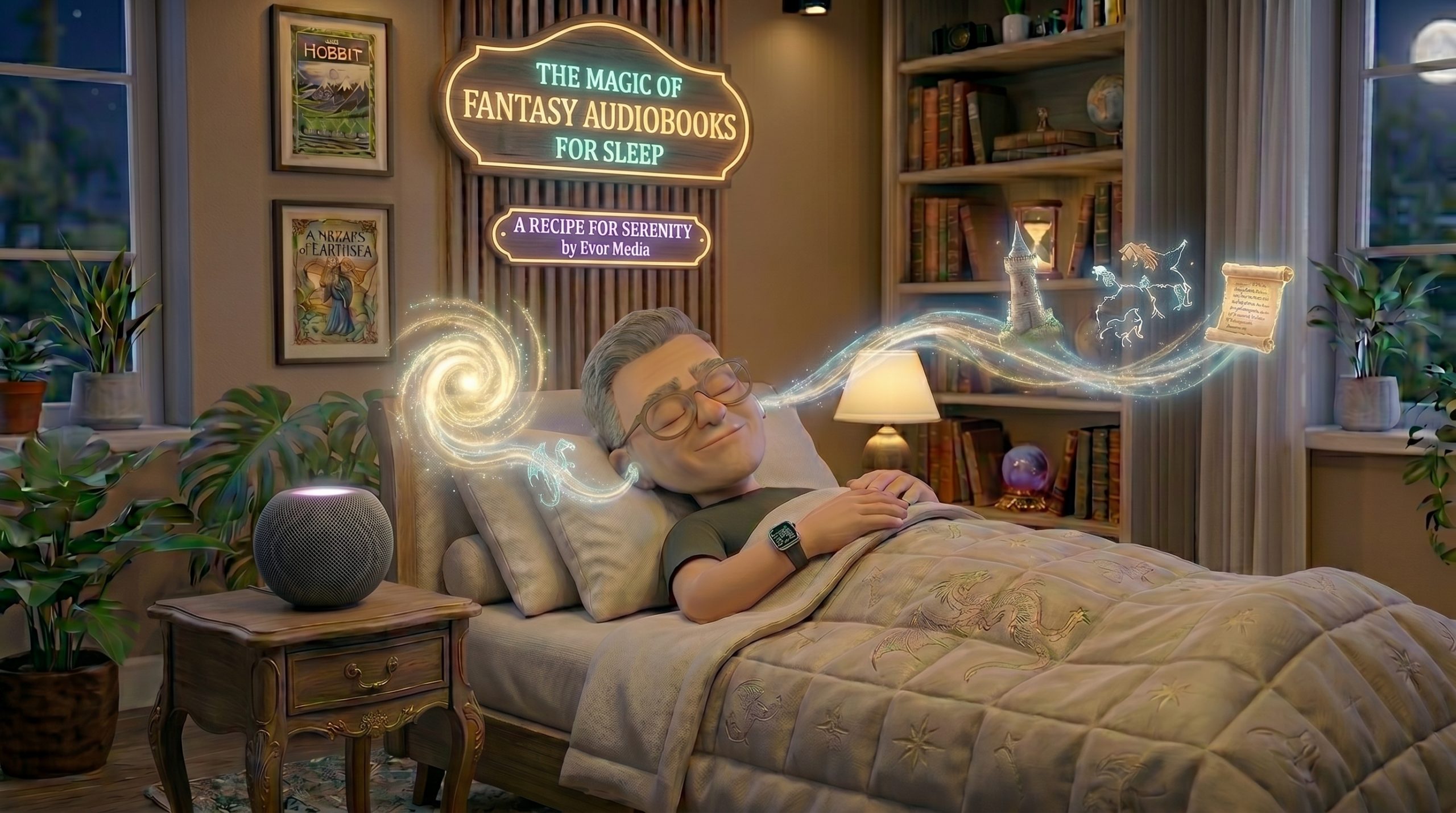
I fall asleep every single night to an audiobook. Not to white noise, not to guided meditations, and certainly not to the doom-scrolling silence of a dark phone screen. I fall asleep to fiction. Specifically, to fantasy.

For the uninitiated, this might sound counterintuitive. Isn’t sleep about quieting the mind? Don’t stories keep you up, turning pages until 3:00 AM? Usually, yes. But when you switch from reading with your eyes to listening with your ears, and when you choose the right genre, the bed becomes a magic carpet. Here is why sleeping with audiobooks, specifically fantasy fiction has turned my nights from a battlefield of anxiety into a magical experience.

The Paradox of the Plot

Let’s address the obvious objection first: “Doesn’t a gripping plot keep you awake?”

It can. If you are listening to a high-stakes thriller where a bomb is ticking down, or a mystery where the detective is about to unmask the killer, your adrenal glands will not cooperate with sleep. I learned this the hard way. But fantasy is different.

Fantasy operates on a different rhythm. Yes, there are battles and betrayals, but the texture of good fantasy is immersive rather than suspenseful. Fantasy relies on world-building. It lingers on the smell of rain in a cobblestone alley, the weight of a cloak, the specific way the light hits a crystal tower. These are not high-octane details; they are sedatives.

When you listen to a fantasy audiobook at a low volume, your brain isn’t waiting for a jump scare. It is processing a landscape. The narrative becomes a lullaby with a plot. You aren’t clinging to the edge of your seat you are sinking into the mattress of a fictional inn.

The Voice as a Vessel

There is a reason why we read bedtime stories to children. It is not about the plot of a Winnie the Pooh story; it is about the sound of safety. As adults, we forget that we still crave that.

My nightly ritual begins with selecting a narrator. I have my favourites, those with warm, slightly gravelly voices. British accents work particularly well (there is something about the formality that signals “story time”). I avoid narrators who are overly theatrical or who shout during action sequences. I look for the ones who read like they are telling a secret.

There is a unique intimacy to an audiobook. The narrator is speaking directly into your ear, usually through a high-quality microphone that captures every breath and inflection. In a world where we spend our days being yelled at by notifications, having a calm, steady voice tell you a story about dragons is a form of auditory therapy.

When that voice describes a character pulling up a blanket by a campfire, my body instinctively mimics the action. When the narrator lowers their volume to describe a character falling asleep in an elven grove, my own breathing syncs up. It is a form of mimicry. The characters rest, so I rest.

The Anti-Anxiety Shield

Here is the psychological truth that no one tells you about insomnia: silence is loud.

When you lie down in a perfectly dark, quiet room, your brain panics. It fills the void. It starts reviewing the embarrassing thing you said in 2014. It starts worrying about the email you forgot to send. It calculates your finances. Silence is an echo chamber for anxiety.

Sleeping with an audiobook solves this by providing what psychologists call a “cognitive anchor.” You cannot ruminate about your job review if you are trying to visualize a griffin soaring over a parapet. Your brain has a limited bandwidth. By feeding it a fictional world one with rules, maps, and magic you starve your anxiety of the attention it needs to survive.

I don’t listen to books I’ve never heard before. That is the rookie mistake. If I put on a brand new, highly anticipated sequel, my brain stays engaged because it wants to know what happens next. That is for the daytime.

For sleeping, I listen to re-reads. I listen to books I love so much that I know them by heart. I know that the hero survives the swamp. I know that the villain gets his fate that is fully deserved. Because I know the ending, my brain relaxes. There is no suspense, only comfort. It is the literary equivalent of a weighted blanket.

Currently, my rotation includes The Hobbit (narrated by Andy Serkis, though I skip the Gollum scenes because they are too intense), the Harry Potter series (Jim Dale’s voice is a sedative), and anything by Joe Abercrombie with Steven Pacey’s amazing narration.

The Ritual of the Sleep Setup

You cannot just throw earbuds in and hope for the best. Sleeping with audiobooks is a craft. Over the years, I have perfected the equipment.

First off, if you’re a side sleeper, you’ll want to get some sleep-specific earbuds. Regular earbuds can be a pain when you roll over, and you might end up losing them in bed, plus the battery won’t last the whole night. I’ve been using the Soundcore Sleep A30 by Anker, but remember, everyone’s ears are different, so take some time to look around and find the perfect sleep-specific earbuds for you.

Second, the sleep timer. This is non-negotiable. I set my timer for 30 or 45 minutes. I almost never make it to the end. In the morning, I rewind 15 minutes from where I fell asleep, and I listen to those same 15 minutes the next night. I have been “reading” the same 200-page book for three weeks, and it is glorious.

Third, volume control. The volume should be so low that you have to strain *just slightly* to hear it. That slight strain forces your brain to focus, which paradoxically relaxes your body. If it is too loud, it is intrusive. If it is too quiet, it becomes a whisper you chase into sleep.

Why Fantasy, Specifically?

I have tried other genres. Literary fiction is too depressing, I don’t want to hear about a crumbling marriage while I drift off. Non-fiction is too interesting, I will stay awake to learn about the Roman Empire.

Fantasy hits the sweet spot because it is alien enough to distract you, but emotional enough to comfort you.

I don’t want to fall asleep in my bedroom, I want to fall asleep in the Shire. I want to be on a ship sailing toward the Unknown. I want to be a mage in a tower, watching the stars through a telescope. Fantasy grants you permission to leave your body. And falling asleep is, after all, the ultimate act of leaving.

When you are struggling to sleep, you are hyper-aware of your own body. Your pillow is too hot. Your leg itches. Your heart is beating. Fantasy pulls the camera away from your physical self and puts it on a character who is sleeping in a hayloft after a long day of questing. You vicariously experience their exhaustion, their release.

The Morning After

The best part of this habit is not even the falling asleep; it is the waking up.

Because I fall asleep inside a story, I often wake up with the residue of that world in my head. I wake up wondering what the hobbits are having for second breakfast. I wake up feeling like I just traveled somewhere. It removes the shock of the alarm clock. Instead of jerking awake into the grey reality of a Tuesday morning, I surface slowly from a fog of magic.

Furthermore, because I fell asleep listening to a voice rather than scrolling TikTok or watching Netflix, which emits blue light that destroys melatonin, my sleep quality is noticeably better. I dream more vividly. I remember my dreams more often. I wake up feeling like my brain actually did the maintenance work it was supposed to do.

A Word of Caution

If you try this, be patient. The first few nights, you will stay up listening. That is fine. Let yourself get through the first few chapters at normal waking volume. Then, when you are ready to sleep, rewind to the beginning of the chapter and lower the volume. Turn on the sleep timer. Let the familiar words wash over you.

Do not use action-heavy books. Avoid battles. Avoid chase scenes. Avoid narrators who scream. You are looking for the travel portions of fantasy the walking through meadows, the sitting by fires, the descriptions of feasts, the quiet conversations in libraries.

The Final Chapter

I used to fear bedtime. I used to lie there, heart racing, watching the red numbers on the clock tick toward sunrise. I tried melatonin, breathing exercises, and the military method. Nothing worked until I realized that my brain didn’t need silence. It needed a different kind of noise.

It needed a story.

Now, when I turn out the light, I feel excitement, not dread. I get to go on an adventure, and then I get to fall asleep during it. I get to be the character who closes their eyes at the inn, knowing the wizard will keep watch.

If you struggle to sleep, if your mind races, if you feel lonely in the dark—try it. Download a fantasy audiobook you already love. Find a narrator with a voice like honey. Press play. Close your eyes. And let the magic carry you somewhere else.

Because the best bedtime story isn’t the one that ends with “The End.”

It’s the one you never finish.

Sweet dreams and may your dreams be filled with dragons.