
Without Falling for Music Marketing
If you have spent even five minutes shopping for earbuds online, you have likely been buried under an avalanche of marketing jargon. Words like “sound stage,” “dynamic range,” “pristine treble,” and “punchy bass” are splashed across every box and product page.
But here is a hard truth that the audio industry doesn’t want you to hear: Most of that doesn’t matter for spoken word audio.
If you primarily listen to audiobooks, podcasts, lectures, or news commentary, you are navigating a very different buying landscape than a hardcore music fan. When you are listening to a narrator tell a story for six hours straight, you don’t need to feel the kick drum in your chest. You don’t need to hear the second violinist breathing. You need clarity, endurance, and sanity.
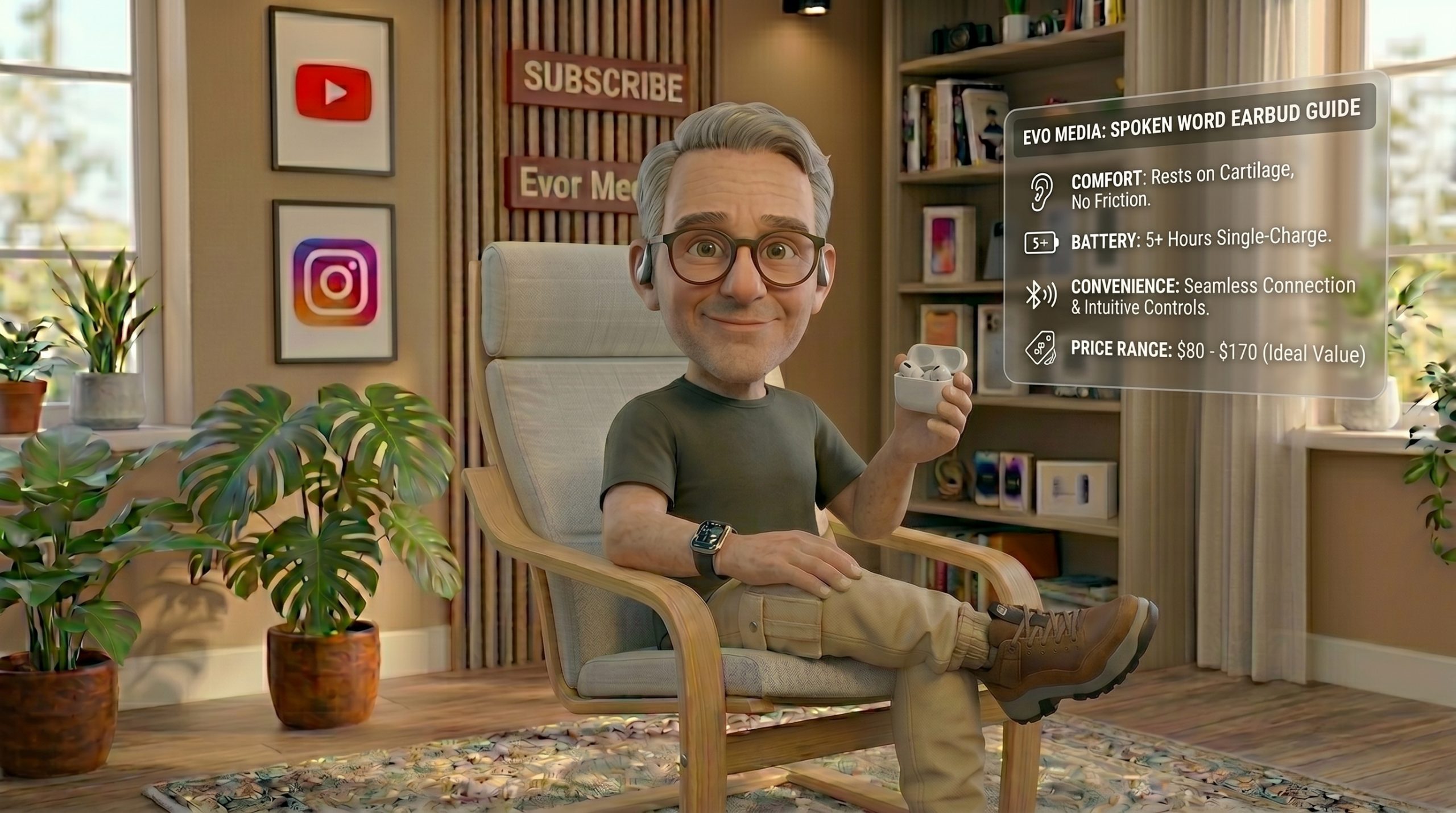
For spoken word entertainment, the decision comes down to just four factors: Comfort, Battery Life, Convenience, and Cost.
These four pillars are intertwined. You rarely get one without sacrificing another. But if you understand how they work together, you can avoid spending $300 on features you will never use. Let’s break it down.
Comfort: The Secret Is Frictionless FiT
When I listen to an audiobook, I am usually in for the long haul. I am not just listening for a three-minute song on the treadmill. I am listening while doing yard work, washing dishes, falling asleep on an airplane, or walking the dog for an hour. That means those little buds might be in my ears for four, five, or even six hours at a stretch.
Comfort is not a luxury for spoken word listeners. It is a necessity.
Here is the tricky part: every ear is unique. What feels like a fluffy cloud in my ear might feel like a torture device in yours. There is no universal “most comfortable earbud.” However, I have discovered a critical engineering principle that separates okay earbuds from great spoken-word earbuds.
The real secret is to avoid earbuds that rely on friction to stay in place.
Think about the standard rubber-tipped earbud that you twist into your ear canal. Those rely on friction the rubber pressing against the walls of your ear canal to hold tight. This has two major drawbacks for long-form listening:
- Moisture destroys the hold. As you wear them, your ears generate moisture (sweat, oils). That moisture turns friction into a slip-and-slide. Suddenly, you are pushing the earbuds back in every five minutes.
- Motion jars them loose. Chewing, walking, or smiling can break the friction seal.
What you actually want is an earbud that doesn’t rely on friction, but rather rests passively in the cartilage of your outer ear. This is the genius of the classic Apple AirPod design (the hard plastic “slip-fit” style). The earbud sits in the bowl of your ear, held gently by the tragus and anti-tragus cartilage. It isn’t jammed into the canal; it is resting in the architecture of your ear.
Does this design leak sound? Yes. Does it have less bass? Absolutely. But for spoken word, you don’t need a perfect seal. You need to forget you are wearing them for three hours. Look for “semi-in-ear” designs or open-fit designs if comfort is your absolute priority.
Battery Life: Don’t Let the Case Lie to You
Nothing ruins a great chapter twist like the robotic voice saying, “Battery low. Please recharge.”
When shopping for earbuds for spoken word, you need to look at two distinct numbers, and you need to know which one matters most:
- Number One (The Buds): The hours of listening the earbuds will deliver on a single charge (the battery built into the earbud itself).
- Number Two (The Case): The total hours including the charging case (the backup battery in your pocket).
Here is the mistake most people make: they see “24 hours of battery life” on the box and click “Buy.” But those 24 hours usually break down into 5 hours of buds + 19 hours from the case.
For spoken word listening, the single-charge number is king.
Why? Because you cannot hot-swap earbuds in the middle of a podcast. If you have a 10-hour flight and your buds only last 4 hours on a charge, you will be sitting in silence for 6 hours while they sit in the case recharging.
My hard rule: Never buy earbuds that offer less than 5 hours of continuous playback on a single charge. Ideally, look for 7 to 10 hours.
Using my AirPods as an example: they offer 5 hours of listening on a single charge and 24 hours total including the case (meaning the case can recharge them about five times). Five hours is the absolute floor. If you see a cool pair of $30 buds that only last 3 hours per charge, leave them on the shelf. They are not ready for the long-form listening lifestyle.
Convenience: The Ecosystem Tax (Worth Paying)
Convenience is the hardest factor to measure on a spec sheet. You cannot quantify “frustration.” But you know it when you feel it.
For spoken word, convenience breaks down into three specific behaviours:
A. How easily do they connect to my phone?
With music, you might tolerate a 15-second Bluetooth pairing dance because you are going to listen to an album you love. With spoken word, you often listen in short bursts—10 minutes here, 15 minutes there. If it takes 30 seconds to pair, you will stop listening. You want “instant on.” Open the case, put them in your ears, and hear the audio before the podcaster finishes their intro.
B. How reliable is the connection?
You cannot have dropouts. A dropped beat in a song is annoying. A dropped syllable in an audiobook mystery means you missed the killer’s name. You need a rock-solid connection that works through walls, pockets, and while your phone is in the backyard and you are in the kitchen.
C. How usable are the physical controls?
This is where many budget earbuds fail the spoken word test. You need to be able to Pause. Constantly.
If you are listening to a book and the delivery driver knocks, you need a tactile, reliable way to pause instantly. Capacitive touch controls that activate when you brush your hair? Terrible. Small buttons that require you to jam the bud into your ear? Worse.
The Ecosystem Effect:
Here is the inconvenient truth. If you are deeply embedded in an ecosystem (Apple, Samsung, Google), the earbuds made by that ecosystem usually offer the best convenience. Apple AirPods with an iPhone are magical. Samsung Galaxy Buds with a Galaxy phone are similarly seamless. The pairing is instant, the controls are integrated into the OS, and the reliability is top-tier.
You pay a “convenience tax” for this. It is often 50% more expensive than comparable generic hardware. But for spoken word listeners who value sanity over savings, it is frequently worth it.
Cost: The Law of Diminishing Returns
Finally, we get to the wallet. Cost is deeply personal, but the market has clear rules of thumb.
Generally speaking, you get what you pay for. A $15 pair of no-name earbuds from the gas station will fail on comfort, battery, and convenience. They will hurt your ears, die in 90 minutes, and refuse to pair on a Tuesday.
However, the spoken word listener has a massive advantage over the audiophile. You do not need to chase the high end:
- The Sweet Spot ($50 – $80): This is your zone. At this price point, manufacturers have figured out how to make comfortable ergonomics, decent battery life (5-6 hours), and reliable Bluetooth 5.0+ connections. You will get a great sounding product for podcasts and books. Voices will be clear. Sibilance (that harsh ‘S’ sound) will be controlled. You will be happy.
- The Danger Zone ($100 – $200): In this range, you are paying for better drivers, active noise cancellation (ANC), and advanced codecs (AAC, aptX). Do you need ANC for spoken word? Maybe if you commute on a subway. But often, ANC creates “ear pressure” that is uncomfortable for long sessions. You are paying for music features here.
- The Luxury Zone ($200+): Beyond $200 (AirPods Pro 2, Sony WF-1000XM5, etc.), it becomes incredibly hard to identify the sound quality difference *for human speech*. You are paying for luxury materials, brand tax, and marginal improvements in bass response. You do not need this for a narrator reading a thriller.
My advice: Spend at least $50 to avoid the junk. Try very hard not to spend over $150. The return on investment for spoken word audio flatlines above that threshold.
The Final Verdict
The marketing departments want you to think you need a concert hall in your ears. You don’t. You need a comfortable chair for your brain.
When you walk into the store or scroll through Amazon, ignore the “dynamic range” and “sound stage” stats. Ask yourself four simple questions instead:
- Comfort: Do they rest in my cartilage, or do I have to jam them into my canals?
- Battery: Do they last at least 5 hours on a single charge?
- Convenience: Will they instantly pair with my phone every single time?
- Cost: Am I staying in the $50–$150 “sweet spot”?
Find the earbuds that check those boxes, and you will have a listening companion that lasts through every chapter, every commute, and every chore. And isn’t that the whole point of a good story?