From Radio Dramas to Podcasts

What Changed…and What Didn’t
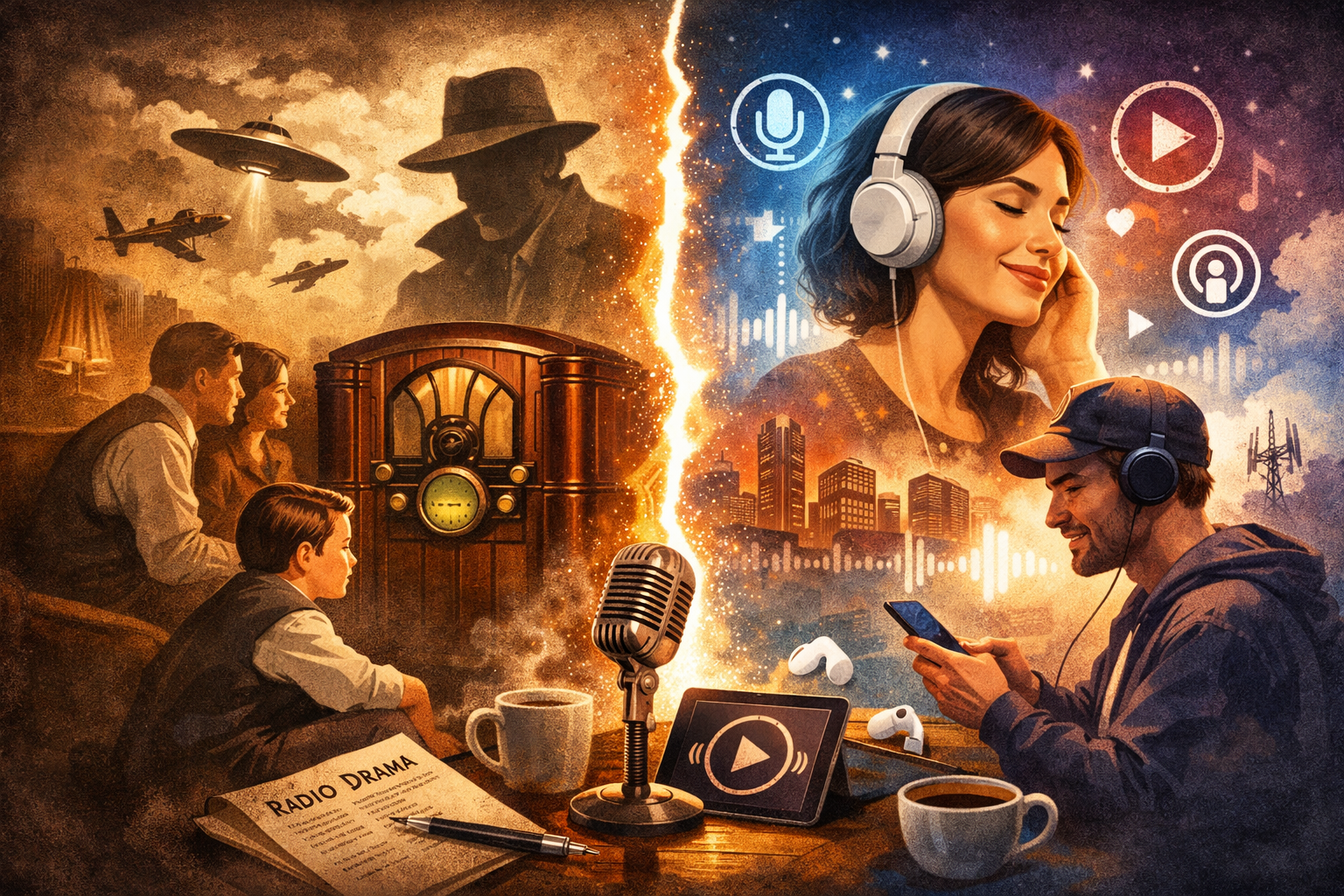
There was a time when families would gather around a radio, waiting for a story to begin

  • Not scrolling.
  • Not skipping.
  • Waiting.

In the 1930s and 40s, radio dramas weren’t just entertainment—they were events. Shows like The Shadow radio program and The War of the Worlds broadcast captured the imagination of millions. People sat together, listening closely, building entire worlds in their minds from nothing but sound.

Today, we live in what feels like a completely different universe. Podcasts stream on demand. Audiobooks follow us everywhere. Voices live in our ears through devices like Apple AirPods.

But when you strip away the technology, something surprising becomes clear:

  • A lot has changed.
  • And almost nothing has.

What Changed: Control, Convenience, and Choice

The biggest shift from radio dramas to podcasts is simple: control.

In the golden age of radio, you listened when the show aired. Miss it, and it was gone. That limitation created a kind of shared rhythm—entire cities tuned in at the same time.

Today, podcasts have flipped that entirely.

  • Listen anytime
  • Pause, rewind, skip
  • Choose from millions of shows

Platforms like Spotify and Apple Podcasts have made audio deeply personal. Your listening habits are no longer shaped by a broadcast schedule—they’re shaped by you (and, increasingly, by algorithms).

It’s better in almost every measurable way.

But it’s also different in ways that are harder to measure.

What Changed: From Shared Rooms to Personal Spaces

Radio was a room experience.

Podcasts are a headphone experience.

That shift—from speakers to earbuds—quietly transformed how we connect through audio. What was once communal is now individual. We’ve traded the living room for the inside of our own heads.

We don’t gather to listen anymore.

We listen alone—together, but separate.

And while that independence is powerful, it comes with a subtle cost: fewer shared moments.

What Didn’t Change: The Power of Voice

Despite all the technological change, the core of audio storytelling remains exactly the same…a voice, telling a story.

Whether it’s a 1940s announcer leaning into a microphone or a modern podcast host speaking into a USB mic, the connection is still deeply human. Audio has an intimacy that video often lacks.

There’s no screen to distract you.

No visuals to define things for you.

Just voice—and your imagination filling in the rest.

That hasn’t changed at all.

What Didn’t Change: Imagination Does the Heavy Lifting

One of the most powerful things about radio dramas was what they didn’t show you.

There were no visuals—only suggestion. A creaking door. Footsteps in the dark. A pause in someone’s voice…your mind did the rest.

Podcasts—especially narrative ones—still rely on that same magic. Even today, the best audio stories don’t overwhelm you with detail. They leave space.

Space for you to imagine…space for you to participate.

In a world dominated by screens, that feels almost radical.

The Middle Ground We’re Still Figuring Out

If radio was communal and podcasts are personal, we’re still trying to figure out what comes next.

We have the tools to bring shared listening back—smart speakers, voice assistants, multi-room audio. Devices like the 

Apple HomePod smart speaker can easily fill a room with sound.

But the habit isn’t there:

  • We’ve grown used to listening alone.
  • Curating our own tastes.
  • Rarely compromising on what we hear.

And yet, there’s something missing.

A Small Experiment in Shared Listening

My wife and I have stumbled into a small way of reclaiming that lost connection.

When we go for walks, we share a single pair of AirPods—she takes the right, I take the left—and we listen to the same podcast.

It’s a simple thing. Almost silly.

But it creates moments that feel surprisingly rare: both of us reacting at the same time, stopping mid-step, looking at each other after hearing something that lands.

That shared reaction—that unplanned, synchronous moment—is something radio listeners in the 1940s would have recognized instantly.

The Real Difference

So what really changed?

  • Not the storytelling.
  • Not the voice.
  • Not the imagination.

What changed is how we experience it together.

Radio made listening a collective ritual.
Podcasts made it a personal habit.

Neither is inherently better. But one of them brought people into the same moment—and the other lets us drift into our own.

Final Thoughts

We didn’t lose the magic of radio when podcasts arrived. In many ways, we expanded it.

We just redistributed it—from the room to the individual.

Maybe the next evolution of audio isn’t about better technology or smarter algorithms.

Maybe it’s about rediscovering something much older:

Listening, not just at the same time—
but together.
The Golden Age of Radio vs. The Golden Age of Audio:

What We’ve Lost (and How to Get It Back)

I’ve had a long-standing romance with old-time radio, especially the magic of the 1940s. Sometimes it feels like I was born in the wrong era. There’s something deeply compelling about the image of a family gathered around a beautiful wooden console radio, completely immersed in a shared story.

The Magic of 1940s Radio

In the 1940s, radio wasn’t just background noise, it was an event.

Families would gather around large console sets like the Zenith 12S471 floor console radio, tuning in to dramas, comedies, and news broadcasts. Each listener imagined the scenes differently, yet everyone experienced the same story at the same time. That balance, individual imagination paired with collective experience—was the true magic of the golden age of radio.

It was simple. It was shared. And it was powerful.

Today’s Golden Age of Audio

Fast forward to today, and we’re living in what could easily be called the golden age of audio. Podcasts, audiobooks, and streaming music are more accessible than ever. Devices like the Apple AirPods and Apple HomePod smart speaker have made listening effortless and ubiquitous.

But here’s the paradox: while access has improved, connection has diminished.

Wireless headphones have revolutionized how we consume audio, but they’ve also quietly isolated us. We’ve become a society of solo listeners, each in our own personalized audio bubble.

The Problem with Personalized Listening

The convenience of earbuds has shaped our habits in subtle ways:

  • We listen alone, even when we’re together
  • Algorithms replace shared discovery
  • Audio becomes individualized instead of communal

There was a time when discovering new music or shows meant listening with others, friends, family, even strangers. Today, algorithms are more efficient, but they lack the human element that made discovery meaningful.

A Small Rebellion: Sharing One Pair of Headphones

My wife and I have found a small way to push back against this trend.

When we go for walks, we could easily each put in our own headphones and listen to separate things. But we don’t.

Instead, she uses the right AirPod, and I use the left. We listen to the same podcast or audiobook, together.

It sounds trivial, but it changes everything.

We’ve had moments where we both stop walking at the exact same time, hearing a powerful “mic drop” moment, and just look at each other. No words needed. That shared reaction is something you simply don’t get when listening alone.

That’s the missing ingredient in today’s golden age of audio: shared experience.

Could Smart Speakers Bring It Back?

There’s hope.

Devices like smart speakers make it possible to recreate that communal listening experience. It’s not hard to imagine a modern version of a 1940s living room, family or friends gathered around, listening to an audio drama after dinner.

Maybe it’s a podcast. Maybe it’s an audiobook. Maybe it’s something entirely new.

The technology is here.

The habit is not.

When Radio Became Television

There’s an interesting parallel from history.

In the 1950s, as television emerged, many successful radio shows transitioned to the new medium. But something was lost in translation.

My father, who grew up in the 1940s, once told me about the disappointment of seeing his favorite radio characters on television. The faces on the screen didn’t match the ones he had imagined.

Radio invited participation. Television replaced it.

Why 1940 Was the Peak

If there was a peak moment for radio, it was likely around 1940.

Radio rose in the mid-1920s and began fading by the early 1950s as television took over. By the late 1940s, broadcasters were already shifting their focus away from radio. That makes 1940 a kind of sweet spot—when the medium was mature, widely adopted, and still culturally dominant.

It’s no coincidence that iconic radios like the Zenith 12S471 came from this era. They weren’t just appliances, they were the centrepiece of the home.

Recreating the Golden Age Today

Maybe I’m romanticizing the past. Probably.

But I can’t shake the vision of a near future where we reclaim some of what made that era special.

A quiet evening. A cup of tea or coffee. A room filled with people. And a story playing, not through isolated earbuds, but out loud, shared.

Maybe it’s through a modern speaker instead of a wooden console. Maybe the content is a podcast instead of a radio drama.

But the feeling?

That could be the same.

Final Thoughts

We didn’t lose the magic of audio—we just changed how we experience it.

The golden age of radio was about togetherness.
The golden age of audio is about choice.

The next evolution might be about finding a way to have both.

And maybe it starts with something as simple as sharing a single pair of headphones.